
Search engine optimization is experiencing its most transformative shift in over two decades. If you are a student, young developer, or entry-level marketer entering the digital world, you might have heard dramatic statements claiming that “SEO is dead” or that artificial intelligence has made search engines obsolete.
The reality is far more interesting: search is not dying; it is multiplying.
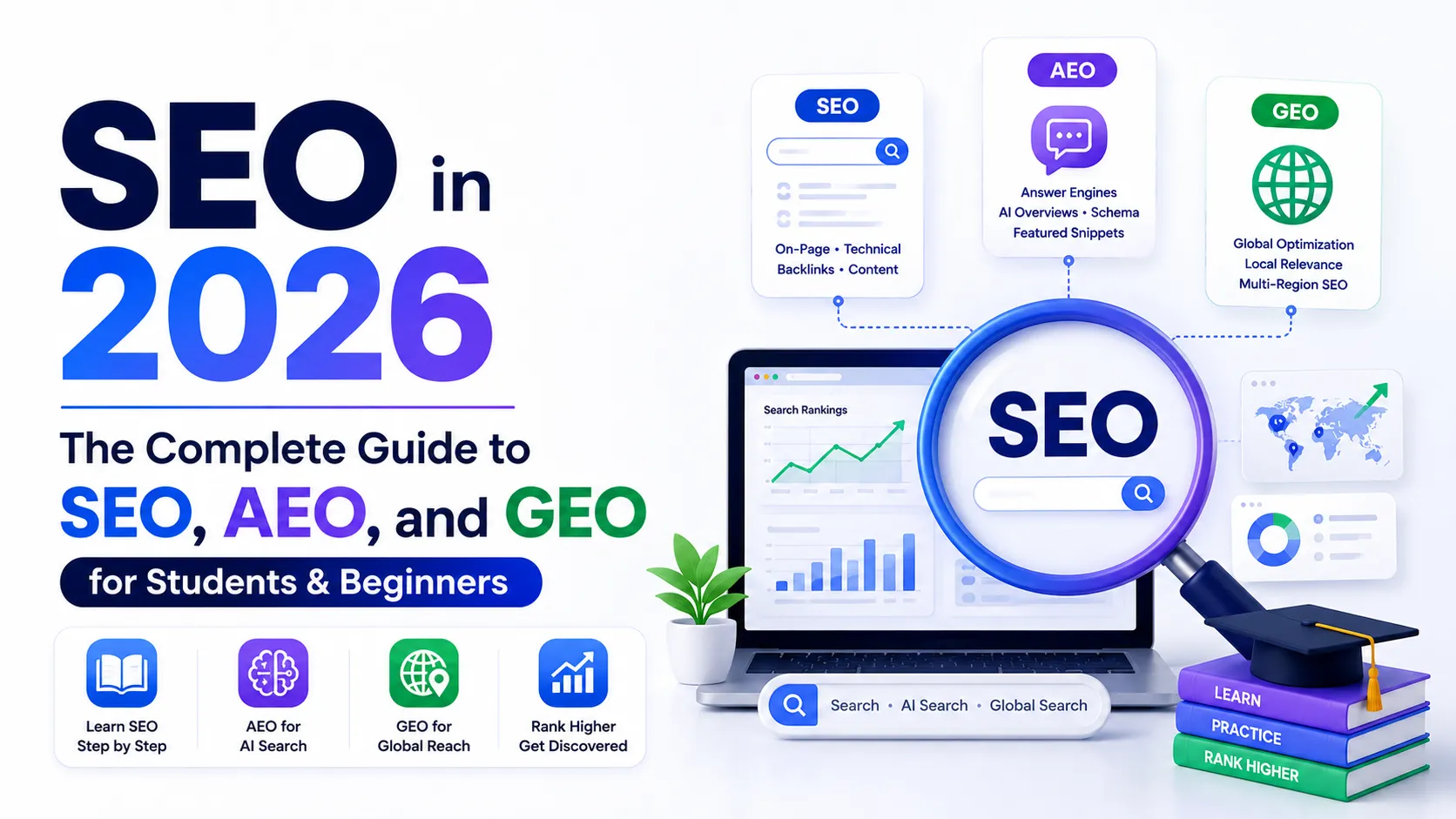
In 2026, search engine optimization has expanded beyond basic keyword placement and backlink building. It now encompasses three distinct, interconnected disciplines known as the Tri-Search Engine Architecture: Classic Search Engine Optimization (SEO), Answer Engine Optimization (AEO), and Generative Engine Optimization (GEO).
This guide breaks down how search engines and AI engines work in 2026, explains what you need to learn to build a successful career or project, and provides a clear blueprint to optimize content for both human readers and AI systems.
Direct Answer: What is SEO in 2026?
SEO in 2026 is the holistic practice of optimizing digital content so it ranks in traditional search engine results (like Google), provides direct zero-click answers for AI overviews and voice assistants (AEO), and gets cited or recommended by Large Language Model engines like ChatGPT Search, Google Gemini, and Perplexity (GEO).
1. The Anatomy of Search in 2026: The Tri-Search Framework
To understand search today, we must look at how user queries are processed. When someone types or speaks a question into a phone or computer, intelligent routing algorithms decide whether to show organic web links, trigger a zero-click direct answer, or generate a synthesized AI snapshot.
                               +----------------------------------+
                               |        USER INPUT QUERY          |
                               | (Text, Voice, Image, Live Video) |
                               +----------------------------------+
                                                |
                                                v
                               +----------------------------------+
                               |     AI RETRIEVAL & RAG ROUTER    |
                               +----------------------------------+
                                    /           |           \
                                   /            |            \
                                  v             v             v
                    +------------------+ +--------------+ +--------------------+
                    |  CLASSIC SEO     | |  AEO ENGINE  | |  GEO / LLM ENGINE  |
                    | Organic Web SERP | | Direct Zero- | | Generative AI      |
                    | & E-Commerce     | | Click Answer | | Citations        |
                    +------------------+ +--------------+ +--------------------+
Pillar 1: Classic Search Engine Optimization (SEO)
Classic SEO remains the bedrock of web discovery. It focuses on getting web pages indexed, crawled, and ranked in search engine results pages (SERPs).
- Primary Focus: Transactional keywords, product catalogs, in-depth technical guides, and core page authority.
- Key Mechanics: Site architecture, XML sitemaps, page speed, mobile performance, clean code, and relevant backlinks.
- Why It Still Matters: When users want to make a purchase, download software, or read primary editorial reporting, they click through to organic links. High-converting transactional intents still run primarily on classic web crawling and indexing.
Pillar 2: Answer Engine Optimization (AEO)
AEO focuses on capturing direct, single-source answers displayed at the top of search results, in Google AI Overviews, or spoken via voice assistants.
- Primary Focus: Immediate informational queries (e.g., “What is the capital of India?”, “How to calculate INP in Web Vitals?”).
- Key Mechanics: Concise formatting, structured listicles, concise definitions, and structured schema markup.
- The Zero-Click Economy: Over 65% of simple informational searches end without the user clicking on an external link. AEO ensures your brand gets featured as the trusted source directly inside that initial answer box.
Pillar 3: Generative Engine Optimization (GEO)
GEO is the newest discipline in search optimization. It is the process of structuring web content so Large Language Models (LLMs) and Retrieval-Augmented Generation (RAG) systems cite, synthesize, and recommend your website when answering complex user prompts.
- Primary Focus: Conversational prompts and commercial research queries inside ChatGPT, Perplexity, Google Gemini, and Microsoft Copilot.
- Key Mechanics: High Information Gain Scores (IGS), statistical grounding, entity mapping, and atomic sentence structures.
- The Citation Value: Unlike traditional SERPs where position #1 takes the vast majority of clicks, LLM responses cite 3 to 5 sources simultaneously. GEO ensures your site is consistently included in those AI citation footnotes.
2. Core Drivers of Search Optimization in 2026
If you want your website or client projects to gain visibility today, you must understand three core concepts driving modern search engines.
1. Entity-First Indexing vs. Keyword Density
Years ago, SEO involved repeating a target keyword several times on a page. In 2026, search engines do not just read words; they process Entities.
An entity is a well-defined object, person, place, or concept (e.g., “SoftwareRider”, “Python Programming”, “New Delhi”, “Machine Learning”). Search engines use semantic knowledge graphs to map how these entities connect. Instead of focusing on keyword density, modern optimization requires writing comprehensive content that naturally covers related entity sub-topics.
How to Build an Entity-Focused Article:
- Map out the central entity (e.g., SEO in 2026).
- List secondary related entities (e.g., Schema markup, Core Web Vitals, Google Gemini, Information Gain).
- Connect entities using explicit relationship statements (e.g., “Generative Engine Optimization utilizes Schema markup to feed RAG systems”).
2. Information Gain Score (IGS)
Because generative AI can draft generic articles in seconds, search engines penalize web pages that simply repeat what already exists online.
Information Gain measures how much new, unique, or additional value a document provides beyond top-ranking pages. Content with high information gain includes:
- Original research or student survey data.
- First-hand code implementations or step-by-step tutorials.
- Unique charts, comparison tables, or proprietary frameworks.
- Expert quotes and direct hands-on experience.
3. E-E-A-T 3.0: Verifiable Human Proof
Google’s search guidelines place massive weight on E-E-A-T (Experience, Expertise, Authoritativeness, and Trustworthiness). In 2026, search algorithms look for explicit “proof of work”:
- Did a real human test this software tool or write this guide?
- Are there original screenshots, video clips, or real-world project results embedded?
- Is the author connected to a clear entity profile (e.g., LinkedIn, GitHub, verified personal domain)?
3. Practical Blueprint: How to Structure Content for SEO, AEO, and GEO
Here is a step-by-step workflow you can use when writing blog posts, tutorials, or software guides.
HTML
<!-- Example: The "Answer Capsule" Pattern for AEO -->
<h2>What is Answer Engine Optimization?</h2>
<p class="answer-capsule">
  <strong>Answer Engine Optimization (AEO)</strong> is the practice of structuring content so search engines and AI assistants can instantly extract direct, zero-click answers. It focuses on concise 40–60 word summaries, clear definitions, HTML tables, and FAQ schema markup.
</p>
Step 1: Place an “Answer Capsule” Near the Top
Within the first 200 words of your article, provide a clear, standalone 40–60 word answer to the primary question. This direct format makes it easy for AI Overviews and voice tools to pull your content as a featured answer.
Step 2: Use Atomic Sentences & Statistical Grounding
When presenting facts, write clear, self-contained sentences. AI parsers chop documents into smaller chunks (embeddings) to evaluate relevance.
- Vague: “A lot of people use mobile phones for search in India nowadays.”
- Atomic & Grounded: “Over 75% of web search traffic in India originates from mobile devices, making INP (Interaction to Next Paint) optimization critical for performance.”
Step 3: Implement HTML Tables for Comparisons
LLMs and RAG engines extract information from structured HTML tables with high priority. Whenever comparing tools, frameworks, or strategies, use a clean table rather than dense paragraphs.
Step 4: Add Micro-Summaries to Structural Headings
Under every primary H2 heading, include a one-sentence summary bullet point. This allows AI web crawlers to quickly construct high-level summaries of your document without needing to parse multi-paragraph narrative sections.
4. Deep-Dive: Optimizing for Specific AI Answer Engines
Each AI answer engine relies on slightly different retrieval models and ranking priorities. Here is how to fine-tune your content for the top platforms in 2026.
Optimizing for ChatGPT Search & OpenAI Systems
ChatGPT Search prioritizes high-authority domain citations, clear brand mentions, and natural conversational context.
- Citation Drivers: Unlinked brand mentions across reputable tech blogs, clear organizational schema, and easy-to-read list formats.
- Key Formatting Tip: Use explicit bulleted takeaway boxes at the top and bottom of major sections.
Optimizing for Google Gemini & AI Overviews
Google Gemini integrates directly with Google’s Knowledge Graph and classic web index.
- Citation Drivers: Strong Core Web Vitals, verified author entities, clean semantic HTML5 markup, and direct alignment with “People Also Ask” questions.
- Key Formatting Tip: Add explicit
FAQPageJSON-LD schema containing exact-match questions from search console queries.
Optimizing for Perplexity AI
Perplexity operates as a real-time, search-augmented engine that leans heavily on statistical facts and source freshness.
- Citation Drivers: Recent publication/modification dates, numerical stats with explicit citations, and academic or official source references.
- Key Formatting Tip: Include precise dates, percentages, and peer-reviewed or documentation-backed claims within your text.
5. Comparison Matrix: Traditional SEO vs. Modern AI Search Strategy
| Strategy Feature | Traditional SEO (Pre-2024) | Modern SEO + AEO + GEO Strategy (2026) |
| Primary Goal | Rank on Page 1 (10 Blue Links) | Win Organic Ranks + Zero-Click Answers + AI Citations |
| Target Engines | Google, Bing | Google, Gemini, ChatGPT Search, Perplexity, Claude, Copilot |
| Content Metric | Word count & keyword density | Information Gain Score (IGS) & Entity Depth |
| Bot Management | Focus primarily on Googlebot | Allow GPTBot, PerplexityBot, ClaudeBot, Googlebot |
| Performance Vector | Desktop loading speed | Core Web Vitals 2.0 (INP < 150ms, LCP < 1.2s) & SSR |
| Success Metrics | Organic Clicks & Impressions | Organic Clicks, Share of Model (SoM), Citation Rate |
6. Technical SEO for AI Crawlers: robots.txt Essentials
To ensure AI search engines can cite your research or website, your server configuration must allow their web crawlers. Blocking these bots will make your site invisible inside AI-generated answer snapshot engines.
Here is a balanced robots.txt configuration standard used in modern technical SEO:
Code snippet
# Balanced robots.txt Configuration for SEO, AEO, and GEO
User-agent: Googlebot
Allow: /

User-agent: GPTBot
Allow: /

User-agent: PerplexityBot
Allow: /

User-agent: ClaudeBot
Allow: /

# XML Sitemap Location
Sitemap: https://softwarerider.com/sitemap.xml
Core Web Vitals 2.0 in 2026
Technical performance remains a primary ranking and indexing threshold. Focus on two critical user experience metrics:
- INP (Interaction to Next Paint): Must remain under 150ms. Measures how quickly a page responds when a user clicks, taps, or types.
- LCP (Largest Contentful Paint): Must load under 1.2 seconds. Measures how quickly the primary visual content renders on mobile screens.
7. Structured Data Blueprint: Schema Graph for 2026
To help search engines and LLM parsers connect your content to verified entities, implement a unified Schema Graph using JSON-LD. Place this code inside the <head> tag of your web page:
HTML
<script type="application/ld+json">
{
  "@context": "https://schema.org",
  "@graph": [
    {
      "@type": "BlogPosting",
      "@id": "https://softwarerider.com/seo-in-2026-guide/#article",
      "headline": "SEO in 2026: The Complete Guide to SEO, AEO, and GEO for Students & Beginners",
      "description": "Learn how SEO in 2026 works! Discover the Tri-Search framework—combining traditional SEO, Answer Engine Optimization (AEO), and Generative Engine Optimization (GEO).",
      "inLanguage": "en-IN",
      "mainEntityOfPage": "https://softwarerider.com/seo-in-2026-guide",
      "publisher": {
        "@type": "Organization",
        "@id": "https://softwarerider.com/#organization",
        "name": "SoftwareRider",
        "url": "https://softwarerider.com"
      }
    },
    {
      "@type": "FAQPage",
      "@id": "https://softwarerider.com/seo-in-2026-guide/#faq",
      "mainEntity": [
        {
          "@type": "Question",
          "name": "Is traditional SEO dead in 2026?",
          "acceptedAnswer": {
            "@type": "Answer",
            "text": "No, traditional SEO is not dead, but its role has evolved. While simple informational questions are often answered directly by AI overviews, high-intent transactional, commercial, and technical queries still rely heavily on organic web links."
          }
        },
        {
          "@type": "Question",
          "name": "What is the difference between AEO and GEO?",
          "acceptedAnswer": {
            "@type": "Answer",
            "text": "Answer Engine Optimization (AEO) targets single, immediate zero-click answers in featured snippets and voice assistants. Generative Engine Optimization (GEO) focuses on getting your brand cited, referenced, and recommended inside conversational AI responses generated by LLMs like ChatGPT, Gemini, and Perplexity."
          }
        }
      ]
    }
  ]
}
</script>
8. Step-by-Step Practical Tutorial: Optimizing a Sample Article
Let’s walk through an actual before-and-after transformation of a standard blog section to see how SEO, AEO, and GEO optimizations work in practice.
Before Optimization (Outdated Approach):
Title: SEO Tools
“If you want to do SEO in 2026, you need good SEO tools. SEO tools help you find keywords. There are many best SEO tools for beginners available online today. Keyword research is very important for SEO.”
Why it fails: It has low information gain, lacks factual data, uses generic keyword repetition, and offers zero structural cues for AI parsers.
After Optimization (Modern Tri-Search Approach):
H2: Essential SEO & AI Search Tools for Beginners in 2026
Direct Answer Capsule: Modern search optimization requires tools for traditional keyword analytics, schema validation, and AI citation tracking. The essential entry-level toolkit includes Google Search Console (performance tracking), Schema.org Validator (structured data), and Perplexity AI (citation benchmarking).
Tool Category Top Recommended Tool Primary Use Case Organic Performance Google Search Console Monitoring index status, queries, and INP metrics Schema Validation Schema.org Inspector Verifying JSON-LD entity structures AI Citation Tracking Perplexity / LLM Benchmarks Checking brand referral frequency in generative answers
Why it succeeds: Includes a direct 40-word Answer Capsule for AEO, a clean comparison table for RAG extraction, specific tool recommendations for high Information Gain, and zero artificial keyword stuffing.
9. SEO Career Roadmap for Students in India
For students and young graduates in India, the rise of AI-driven search presents an opportunity. Companies and agencies are actively seeking digital strategists who understand both classic web analytics and AI retrieval systems.
Recommended Skill Stack for 2026
- Technical Fundamentals: Understanding HTML5 semantics, JavaScript rendering, Server-Side Rendering (SSR), and mobile optimization.
- Schema & Data Structuring: Ability to hand-code or generate valid JSON-LD schema (
Article,FAQPage,HowTo). - Data Analysis & AI Benchmarking: Tracking brand performance using Google Search Console alongside AI metric models like “Share of Model” (SoM) and citation frequencies.
- Content Strategy: Building topic clusters, conducting intent analysis, and developing original research projects.
Top Free Resources to Start Learning
- Google Search Central Documentation: The definitive reference for webmaster guidelines and technical search standards.
- Schema.org: Official site for exploring structured data types and properties.
- SoftwareRider Guides: Practical, student-focused software reviews, tutorials, and digital career roadmaps.
Looking to test software tools, explore tech career paths, or level up your digital skills? Explore practical software reviews, tutorials, and tech guides at SoftwareRider.com.
Frequently Asked Questions (FAQs)
Q1: Is traditional SEO dead in 2026?
Answer: No, traditional SEO is not dead, but its role has evolved. While simple informational questions are often answered directly by AI overviews, high-intent transactional, commercial, and technical queries still rely heavily on organic web links.
Q2: What is the difference between AEO and GEO?
Answer: Answer Engine Optimization (AEO) targets single, immediate zero-click answers in featured snippets and voice assistants. Generative Engine Optimization (GEO) focuses on getting your brand cited, referenced, and recommended inside conversational AI responses generated by LLMs like ChatGPT, Gemini, and Perplexity.
Q3: How do I make my website rank in Google AI Overviews?
Answer: Provide direct, well-formatted answers near the top of your section, use structured schema markup, maintain high page speed, and include unique facts or statistics that establish authoritativeness.
Q4: Should I block AI bots like GPTBot in robots.txt?
Answer: If your goal is public visibility, search traffic, and brand recognition, you should allow AI bots. Blocking these crawlers prevents AI search engines from featuring or citing your website.
Q5: What software skills should Indian students learn for an SEO career today?
Answer: Students should learn basic HTML/CSS, Google Search Console, Schema markup (JSON-LD), web performance optimization (Core Web Vitals), and AI retrieval principles.
Summary Checklist: The 2026 Search Launch Kit
Before hitting Publish on any new blog post or web page, run through this quick checklist:
- [ ] Answer Capsule Included: Is there a concise 40–60 word direct answer placed near the top of the article?
- [ ] Information Gain Verified: Does the content include original data, custom visuals, unique code, or hands-on insights?
- [ ] Entity Alignment: Are related sub-topics and concepts naturally integrated rather than repeating single keywords?
- [ ] Structured Formatting: Are comparison tables, bullet points, and clear
H2/H3headings used? - [ ] Valid Schema Integrated: Is JSON-LD (
BlogPostingandFAQPage) validated and embedded in the page? - [ ] AI Crawlers Allowed: Does your
robots.txtpermit indexing by major search and LLM bots? - [ ] Mobile & Core Web Vitals: Does the page load in under 1.2s with INP below 150ms on mobile devices?