

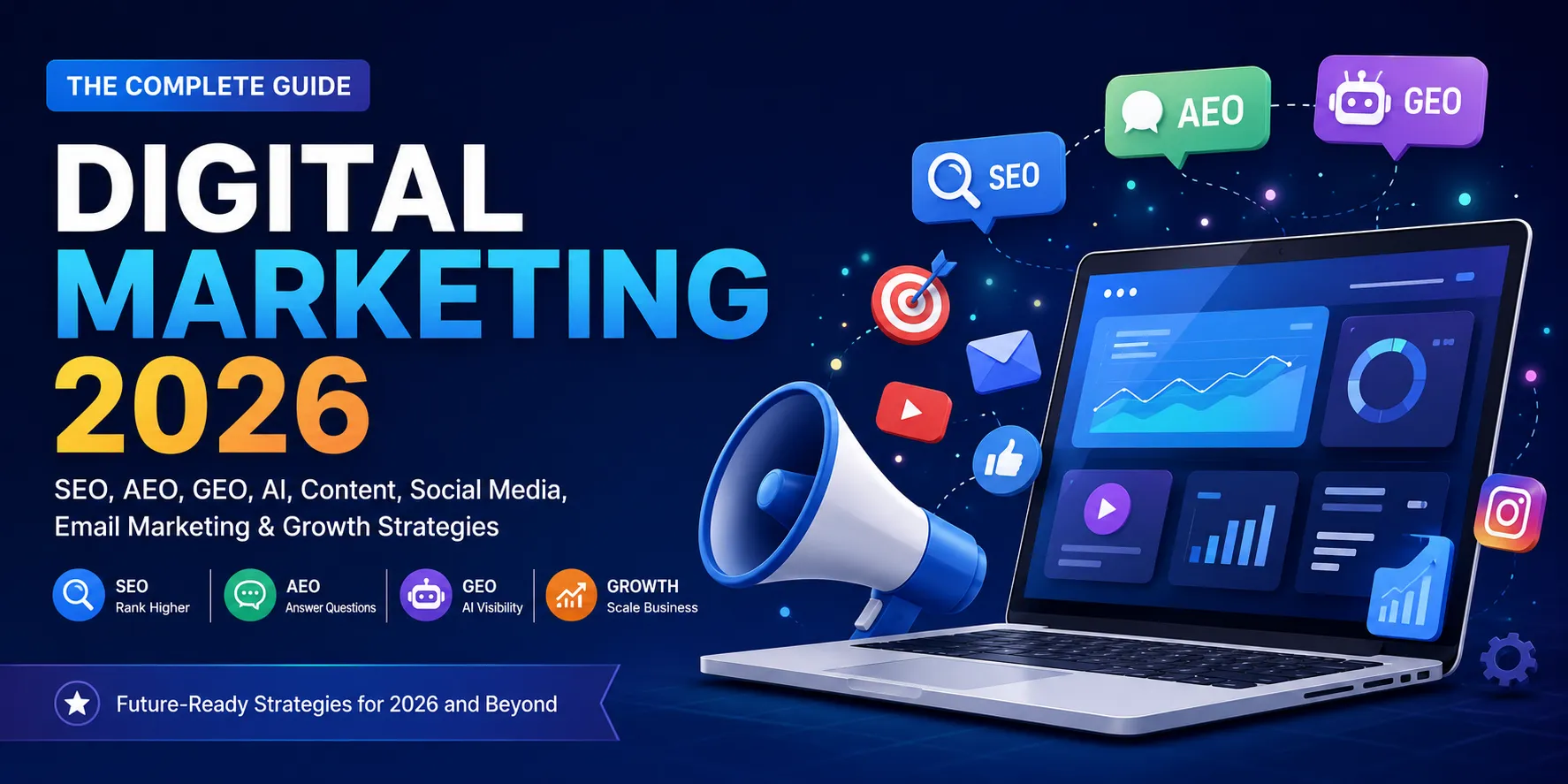
Complete Guide to SEO, AEO, GEO, AI Marketing, Content Strategy & Business Growth
Table of Contents
- What is Digital Marketing?
- Why Digital Marketing Matters in 2026
- SEO vs AEO vs GEO
- AI Search & Google AI Mode
- Content Marketing
- Social Media Marketing
- Email Marketing
- Video Marketing
- PPC Advertising
- Marketing Automation
- Analytics & GA4
- Local SEO
- E-commerce Marketing
- Best AI Marketing Tools
- 2026 Trends
- FAQs
- Final Strategy
1. What Is Digital Marketing?
Digital marketing is the process of promoting products, services and brands using online channels such as search engines, websites, social media, email, video platforms and AI-powered search experiences.
Unlike traditional marketing, digital marketing allows businesses to measure performance, understand customer behaviour, personalise experiences and optimise campaigns using analytics and technology.
Digital Marketing Channels
| Channel | Purpose |
|---|---|
| SEO | Improve organic search visibility. |
| AEO | Make useful content easier for answer engines to understand and surface. |
| GEO | Improve content visibility in generative AI experiences. |
| Content Marketing | Publish blogs, guides, tutorials and resources. |
| Social Media | Reach and engage audiences on platforms such as Instagram and LinkedIn. |
| Email Marketing | Build customer relationships through email communication. |
| PPC Advertising | Reach potential customers through paid advertising. |
| Video Marketing | Educate, demonstrate and engage through video. |
How Digital Marketing Works
Digital marketing connects different activities to help a business attract potential customers and turn them into buyers.
Awareness → Interest → Consideration → Conversion → Retention
- Awareness: People discover your business through search, social media, advertising or referrals.
- Interest: They explore your website, articles, videos or products.
- Consideration: They compare your offering with alternatives and evaluate its value.
- Conversion: They complete an action, such as purchasing or submitting an enquiry.
- Retention: You build relationships that encourage repeat purchases and recommendations.
2. Why Digital Marketing Matters in 2026
Digital marketing is important because customers increasingly use online platforms to discover brands, research products, compare services and make purchasing decisions.
In 2026, businesses also need to understand how AI-powered search and conversational tools influence information discovery. However, the fundamentals remain important: useful content, strong websites, customer trust and measurable marketing activities.
Key Benefits of Digital Marketing
| Benefit | How It Helps a Business |
|---|---|
| Wider Reach | Connect with audiences beyond a local geographical area. |
| Targeted Marketing | Reach relevant audiences based on interests, location and behaviour. |
| Measurable Results | Track traffic, leads, sales and campaign performance. |
| Cost Flexibility | Choose budgets and channels according to business needs. |
| Customer Engagement | Communicate through social media, email and messaging. |
| Brand Awareness | Build recognition through consistent online activity. |
| Business Growth | Identify opportunities and improve marketing decisions using data. |
Why Digital Marketing Is Different in 2026
One important change is the growth of AI-powered search experiences. Users increasingly ask complete questions instead of typing only short keywords. Search platforms are also experimenting with conversational answers, summaries and more interactive experiences.
This means businesses should create content that is useful, accurate, well-organised and easy to understand. It is not enough to publish pages simply to target keywords.
3. SEO vs AEO vs GEO
SEO, AEO and GEO are related approaches to improving online visibility. They focus on different discovery experiences, but they should not be treated as completely separate marketing strategies.
| Strategy | Meaning | Main Focus |
|---|---|---|
| SEO | Search Engine Optimization | Improving visibility in traditional search results. |
| AEO | Answer Engine Optimization | Making content suitable for direct answers in answer-oriented experiences. |
| GEO | Generative Engine Optimization | Improving the likelihood that useful content is discovered, referenced or cited in generative AI experiences. |
SEO: Search Engine Optimization
SEO is the process of improving a website so that its pages can be discovered and appear prominently in unpaid search results.
Important SEO activities include:
- Keyword and search-intent research.
- Helpful, original and relevant content.
- Technical SEO and website performance.
- Internal linking and clear website structure.
- Relevant backlinks and brand reputation.
- Mobile usability and accessibility.
- Indexing and crawling improvements.
Modern On-Page SEO Checklist
- Use one clear, descriptive H1 heading.
- Write a unique and relevant SEO title.
- Create a useful meta description.
- Use a short, descriptive URL.
- Organise content with meaningful H2 and H3 headings.
- Add relevant internal links.
- Optimise images and write descriptive alt text.
- Improve loading performance and Core Web Vitals.
- Make the page mobile-friendly.
- Use relevant structured data where appropriate.
- Check indexing and search performance in Google Search Console.
AEO: Answer Engine Optimization
Answer Engine Optimization focuses on making content clear and useful for systems that provide direct answers to questions.
Best AEO Practices
- Answer important questions directly.
- Use question-based headings where appropriate.
- Include concise definitions and explanations.
- Use comparison tables for related topics.
- Create useful FAQ sections.
- Include practical examples and supporting details.
- Keep information accurate and updated.
Example: What Is AEO?
AEO is the practice of creating and organising content so answer engines can understand it and potentially present it as a direct answer to a user’s question.
GEO: Generative Engine Optimization
Generative Engine Optimization focuses on improving the visibility and usefulness of content in generative AI search and answer experiences.
Generative AI systems may combine information from different sources to create responses. Publishing trustworthy, original and well-supported content can help establish a website as a useful source. However, no GEO technique guarantees that an AI system will cite a particular website.
GEO Checklist
- Publish original research and useful insights.
- Include first-hand experience where relevant.
- Use clear headings and descriptive language.
- Support factual claims with reliable sources.
- Keep important information up to date.
- Build topical coverage through related articles.
- Maintain a clear and trustworthy author and brand identity.
- Use structured data accurately when relevant.
How SEO, AEO and GEO Work Together
Instead of choosing only one approach, create content that serves people across different discovery experiences.
| Activity | SEO Contribution | AEO / GEO Contribution |
|---|---|---|
| Helpful articles | Support organic search relevance. | Provide useful information for answer experiences. |
| Clear headings | Improve page organisation. | Make information easier to interpret. |
| Original examples | Add useful page content. | Demonstrate experience and context. |
| Reliable sources | Support content credibility. | Make claims easier to verify. |
| Internal links | Help discovery and site navigation. | Connect related information. |
4. AI Search & Google AI Mode
AI-powered search experiences are changing how people explore information. Instead of only viewing a list of links, users may receive AI-generated summaries, suggested follow-up questions and conversational responses.
Google’s AI search experiences include AI Overviews and AI Mode. Availability and features can vary by country, language, account and device.
How AI Search Changes User Behaviour
- Users can ask longer, more detailed questions.
- Search experiences can provide summaries alongside links.
- Users may explore follow-up questions in a conversational way.
- Research and comparison journeys can involve multiple sources.
- Websites may receive visits from different search experiences and referral sources.
How to Prepare Your Website for AI Search
- Create content that answers real user questions.
- Use descriptive and meaningful headings.
- Provide accurate information and practical examples.
- Include relevant comparisons and explanations.
- Link to reliable sources when making factual claims.
- Build a clear website structure with useful internal links.
- Keep important articles updated.
- Demonstrate first-hand experience and expertise where possible.
- Make sure important pages are accessible to search crawlers.
There is no special markup or guaranteed shortcut that makes a website appear in every AI-generated answer. Good technical foundations and helpful content remain important.
5. Content Marketing
Content marketing is the process of creating and sharing useful information to attract, educate and engage a target audience.
It can help a business build trust, improve brand awareness, support SEO and guide potential customers towards a purchase decision.
Best Content Types
| Content Format | Main Purpose |
|---|---|
| Blog Posts | Attract organic traffic and answer questions. |
| Guides | Explain topics in detail. |
| Tutorials | Teach users how to complete tasks. |
| Case Studies | Demonstrate real-world results and experience. |
| Product Reviews | Help users evaluate products and services. |
| Comparisons | Explain differences between alternatives. |
| Infographics | Present information visually. |
| Videos | Explain concepts and demonstrate products. |
| Newsletters | Maintain communication with subscribers. |
Pillar and Cluster Content Strategy
A pillar-and-cluster strategy organises related articles around a central topic. A main guide covers the broad subject, while supporting articles explain specific subtopics in more detail.
Example for SoftwareRider:
- Pillar topic: Complete Guide to Digital Marketing.
- Supporting article: SEO for Beginners.
- Supporting article: AEO and GEO Explained.
- Supporting article: Google Ads Tutorial.
- Supporting article: Best Free AI Marketing Tools.
- Supporting article: Social Media Marketing Strategy.
- Supporting article: Google Analytics 4 Guide.
Link related supporting articles to the pillar guide and to one another wherever it helps readers. This creates a logical content structure and makes it easier for visitors to explore related topics.
Content Marketing Best Practices
- Understand your target audience.
- Research search intent before writing.
- Provide useful information rather than repeating existing content.
- Use examples, screenshots and original visuals where appropriate.
- Organise articles with clear headings.
- Add relevant internal and external links.
- Review and update outdated information.
- Measure traffic, engagement and meaningful conversions.
6. Social Media Marketing
Social media marketing involves using social platforms to build brand awareness, communicate with audiences, share content, generate leads and support sales.
Different platforms serve different purposes. A business should select platforms based on its audience, content format and marketing objectives.
Popular Social Media Platforms
| Platform | Suitable Content | Marketing Use |
|---|---|---|
| Professional posts, articles and industry insights. | B2B marketing and professional visibility. | |
| Reels, Stories, photos and carousels. | Visual discovery and brand engagement. | |
| YouTube | Tutorials, reviews and educational videos. | Video discovery and audience education. |
| Community posts, videos, groups and events. | Community building and advertising. | |
| Infographics, visual guides and idea collections. | Visual discovery and website referrals. | |
| X | Short updates and discussions. | Industry conversations and news. |
Social Media Content Strategy
- Educational content that answers audience questions.
- Behind-the-scenes content that shows how a business works.
- Product demonstrations and tutorials.
- Customer testimonials and reviews, used with permission.
- Infographics and visual explainers.
- Industry updates and useful commentary.
- Polls and questions that encourage meaningful discussion.
Example Weekly Publishing Schedule
| Day | Suggested Content |
|---|---|
| Monday | Publish a new blog article. |
| Tuesday | Share an educational LinkedIn post. |
| Wednesday | Publish an Instagram carousel. |
| Thursday | Share a YouTube tutorial. |
| Friday | Send an email newsletter. |
| Saturday | Publish an infographic or short video. |
| Sunday | Respond to comments and review performance. |
This is a sample schedule, not a requirement to publish every day. Consistent, useful content is more valuable than posting everywhere without a clear purpose.
7. Email Marketing
Email marketing is a way to communicate directly with subscribers and customers. Businesses use it to share updates, educational content, promotions, product launches and personalised messages.
Common Email Campaign Types
| Email Type | Purpose |
|---|---|
| Welcome Email | Introduce the business to new subscribers. |
| Newsletter | Share regular news, guides and useful content. |
| Promotional Email | Communicate offers and product promotions. |
| Product Launch Email | Announce a new product or service. |
| Abandoned Cart Email | Remind customers about items left in their cart. |
| Re-engagement Email | Reconnect with inactive subscribers. |
| Transactional Email | Provide order, payment or account information. |
Essential Email Marketing Automations
- Welcome sequence.
- Newsletter subscription confirmation.
- Lead magnet delivery.
- Product launch announcements.
- Customer onboarding.
- Abandoned cart reminders.
- Re-engagement campaigns.
Ideal Email Marketing Funnel
Visitor → Lead → Subscriber → Customer → Loyal Advocate
Build your email list through useful resources, newsletter subscriptions and clear opt-in forms. Obtain appropriate consent, explain what subscribers will receive and provide a simple unsubscribe option.
8. Video Marketing
Video marketing uses video content to explain products, educate customers, demonstrate services and build brand awareness. It is useful for businesses that need to communicate information visually.
Popular Video Content Formats
- Product demonstrations.
- How-to tutorials.
- Customer testimonials.
- Educational explainers.
- Short-form videos.
- Product comparisons.
- Behind-the-scenes videos.
- Live sessions and webinars.
Common Video Aspect Ratios
| Aspect Ratio | Common Use |
|---|---|
| 16:9 | YouTube videos and widescreen displays. |
| 9:16 | Vertical short-form videos and Stories. |
| 1:1 | Square social media posts. |
| 4:5 | Portrait social media feed content. |
Video Marketing Best Practices
- Capture attention quickly without misleading viewers.
- Focus on one clear topic or message.
- Use readable captions and on-screen text.
- Provide a useful title and description.
- Use a relevant thumbnail.
- Include a clear call to action when appropriate.
- Review watch time, audience retention and meaningful clicks.
9. PPC Advertising
PPC stands for Pay Per Click. It is an online advertising model in which an advertiser pays when someone clicks an advertisement.
Paid advertising can help businesses reach people who are actively searching for products or services, or who may be interested in a particular offer.
Common Paid Advertising Platforms
| Platform | Common Advertising Options |
|---|---|
| Google Ads | Search, Shopping, Display, YouTube and Performance Max campaigns. |
| Meta Ads | Facebook and Instagram advertising placements. |
| LinkedIn Ads | Professional and B2B audience campaigns. |
| Microsoft Advertising | Search and audience advertising across supported placements. |
| Pinterest Ads | Promoted pins and visual discovery campaigns. |
Important Advertising Metrics
| Metric | Meaning |
|---|---|
| CPC | Cost Per Click. |
| CPM | Cost Per 1,000 Impressions. |
| CTR | Click-Through Rate. |
| CPA | Cost Per Acquisition or Action. |
| CPL | Cost Per Lead. |
| CVR | Conversion Rate. |
| ROAS | Return on Ad Spend. |
Example: ROAS Calculation
Suppose a business spends ₹10,000 on advertising and generates ₹50,000 in attributed sales revenue.
ROAS = Attributed Advertising Revenue ÷ Advertising Spend
ROAS = ₹50,000 ÷ ₹10,000 = 5x
This means the campaign generated ₹5 in attributed revenue for every ₹1 spent on advertising. It does not mean the business earned ₹4 in profit, because product costs, shipping, taxes, returns and other expenses are not included.
How to Improve Advertising Performance
- Choose a clear campaign objective.
- Understand your target audience.
- Use relevant ad copy and creative assets.
- Match the landing page to the advertisement.
- Track conversions correctly.
- Test different creative and audience combinations.
- Review sales, returns and actual business profitability.
10. Marketing Automation
Marketing automation uses software to perform repetitive marketing tasks based on predefined triggers, rules and customer actions.
It can help businesses communicate consistently, manage leads, send follow-up messages and improve customer experiences.
Common Marketing Automation Workflows
| Workflow | Example |
|---|---|
| Welcome Automation | Send a welcome email after someone subscribes. |
| Lead Nurturing | Send educational emails to potential customers. |
| Abandoned Cart | Send a reminder when a customer leaves products in a cart. |
| Customer Onboarding | Share instructions after a customer signs up. |
| Lead Assignment | Send new enquiries to the appropriate sales representative. |
| Re-engagement | Contact inactive subscribers with relevant updates. |
Example Automation Workflow
Visitor subscribes → Welcome email → Helpful guide → Relevant product information → Follow-up message
Benefits of Marketing Automation
- Reduces repetitive manual work.
- Helps deliver timely communications.
- Supports lead management.
- Improves consistency across customer journeys.
- Helps organise customer information.
- Provides data for evaluating campaign performance.
Automation should support useful communication, not overwhelm people with unnecessary messages. Always respect customer preferences and consent.
11. Analytics & GA4
Analytics helps businesses understand how visitors discover and interact with their websites and applications. It provides information that can guide marketing decisions and help identify opportunities for improvement.
Google Analytics 4 (GA4) is Google’s event-based analytics platform for websites and applications.
Important Analytics Tools
| Tool | Purpose |
|---|---|
| Google Analytics 4 | Measure website and app activity. |
| Google Search Console | Monitor Google Search visibility, indexing and search performance. |
| Google Tag Manager | Manage tracking tags and measurement scripts. |
| Microsoft Clarity | Understand user interactions through supported behaviour analytics features. |
| Looker Studio | Create dashboards and reports from connected data sources. |
Important Marketing KPIs
| KPI | What It Measures |
|---|---|
| Organic Traffic | Visitors arriving through unpaid search results. |
| CTR | Percentage of impressions that result in clicks. |
| Engagement Rate | How often users interact with content or meet a defined engagement condition. |
| Conversion Rate | Percentage of visitors or sessions that complete a desired action. |
| ROAS | Attributed advertising revenue compared with ad spend. |
| Returning Users | Users who return to a website or app during the reporting period. |
| Lead Generation | Number of potential customers generated. |
How to Use Analytics Effectively
- Define the business objective.
- Choose the metrics that measure progress towards that objective.
- Set up analytics and conversion tracking correctly.
- Review traffic sources and user behaviour.
- Identify pages or campaigns that need improvement.
- Test changes and measure the results.
- Review performance regularly.
Do not judge performance using one metric alone. For example, more website traffic is not necessarily better if visitors are not finding relevant information or completing useful actions.
12. Local SEO
Local SEO is the process of improving a business’s visibility in location-based searches. It is especially useful for businesses that serve customers in a particular city, district, neighbourhood or service area.
Examples include restaurants, shops, repair services, clinics, consultants and local agencies.
Important Local SEO Elements
- Google Business Profile: Create and maintain an accurate business profile.
- NAP Consistency: Keep business name, address and phone details consistent where published.
- Local Keywords: Use relevant service and location phrases naturally.
- Customer Reviews: Encourage genuine reviews and respond professionally.
- Local Landing Pages: Create useful pages for the locations and services you genuinely serve.
- Business Categories: Select accurate categories for your business.
- Local Links: Build relevant relationships and mentions from local organisations and websites.
- Mobile Experience: Make it easy for mobile visitors to call, navigate and enquire.
Example: Local SEO for a Digital Marketing Agency
Suppose a digital marketing agency serves customers in Patna. It can create a useful service page describing its digital marketing services in Patna, maintain an accurate Google Business Profile and publish genuine customer testimonials with permission.
The agency should provide accurate business details and avoid creating misleading location pages for places it does not serve.
Local SEO Checklist
- Claim and verify your Google Business Profile.
- Use the correct business name and contact information.
- Choose accurate primary and secondary categories.
- Add genuine business photos.
- Describe your services clearly.
- Collect genuine customer reviews.
- Respond to reviews and enquiries.
- Build relevant local website content.
- Monitor performance and customer actions.
13. E-commerce Marketing
E-commerce marketing involves promoting products and services through online stores and marketplaces. It combines product presentation, advertising, search visibility, customer experience, pricing, inventory and order management.
Important E-commerce Marketing Activities
| Activity | Purpose |
|---|---|
| Product SEO | Improve product page visibility in organic search. |
| Marketplace Advertising | Promote products within online marketplaces. |
| Product Catalogue Management | Maintain accurate product information and variants. |
| Conversion Rate Optimization | Improve the percentage of visitors who purchase. |
| Retargeting | Reconnect with eligible previous visitors or customers. |
| Email Marketing | Share offers, product updates and order-related communication. |
| Customer Reviews | Help shoppers understand product experiences. |
| Inventory Management | Maintain product availability and reduce stock issues. |
Important E-commerce Metrics
| Metric | Meaning |
|---|---|
| AOV | Average Order Value. |
| GMV | Gross Merchandise Value. |
| SKU | Stock Keeping Unit. |
| COD | Cash on Delivery. |
| RTO | Return to Origin. |
| RTV | Return to Vendor. |
| OOS | Out of Stock. |
| PDP | Product Detail Page. |
| PLP | Product Listing Page. |
| ASP | Average Selling Price. |
Example: E-commerce Marketing for an Apparel Brand
An apparel brand selling shirts, trousers and dresses across its website and online marketplaces needs to manage product listings, sizes, colours, product images, prices and stock availability.
The marketing team can promote products through Google Ads and Meta Ads, improve product pages and monitor orders, sales, cancellations, returns and advertising costs.
For a realistic business view, the team should evaluate net sales and profitability rather than relying only on gross sales or advertising-platform revenue.
Ways to Improve E-commerce Sales
- Use clear product images and accurate descriptions.
- Provide useful size guides and product specifications.
- Keep prices and inventory accurate.
- Make checkout simple and secure.
- Display delivery and return information clearly.
- Use relevant product recommendations.
- Monitor cancellations, returns and RTO.
- Measure advertising performance alongside actual profit.
14. Best AI Marketing Tools
AI tools can help marketing teams research ideas, prepare content, create visual assets, analyse information and automate repetitive work. The best tool depends on the task, budget and required features.
Popular AI and Marketing Tools
| Tool | Common Use |
|---|---|
| ChatGPT | Brainstorming, writing assistance, research support and data analysis. |
| Google Gemini | AI assistance, research and supported Google ecosystem workflows. |
| Claude | Writing assistance, document analysis and complex text tasks. |
| Perplexity | Research and source discovery. |
| Canva AI | Design assistance and visual content creation. |
| Adobe Firefly | AI-assisted creative image and design workflows. |
| Google Analytics 4 | Website and app measurement. |
| Google Search Console | Search visibility and SEO monitoring. |
| Google Tag Manager | Tag and tracking management. |
| Microsoft Clarity | Website behaviour insights. |
How AI Helps Digital Marketers
- Content planning: Generate topic ideas and article outlines.
- Writing assistance: Draft and improve content for human review.
- SEO research: Organise keyword ideas and identify content opportunities.
- Creative production: Help develop images, layouts and video concepts.
- Data analysis: Summarise reports and identify patterns.
- Customer support: Assist with frequently asked questions.
- Automation: Support repetitive workflows and reporting tasks.
Important: Use AI Responsibly
AI-generated information can contain errors, outdated details or unsupported claims. Review important facts, verify sources, respect copyright and privacy requirements, and add genuine human experience before publishing.
AI should support expertise and productivity, not replace editorial judgement or customer understanding.
15. Digital Marketing Trends in 2026
Digital marketing continues to evolve as search technology, customer expectations, automation and content formats change. The following developments are important areas for marketers to understand and evaluate.
- AI-Powered Search: Conversational search and AI-generated summaries are changing how users discover information.
- Answer Engine Optimization: Clear, useful answers can help content serve question-based search experiences.
- Generative Engine Optimization: Brands are exploring ways to improve visibility in AI-generated responses.
- First-Party Data: Businesses are focusing on customer data collected directly with appropriate permission.
- Interactive Content: Calculators, quizzes and tools can make websites more useful and engaging.
- Video Discovery: Short-form and educational video continue to play important roles in content strategies.
- Community Marketing: Businesses are investing in meaningful relationships with customers and communities.
- Personalised Automation: Marketing workflows increasingly use customer preferences and behaviour to tailor communication.
- AI-Assisted Analytics: AI tools can help summarise data and support decision-making.
- Experience-Driven Content: Original insights, practical examples and first-hand experience help differentiate useful content.
What Businesses Should Focus On
| Priority | Recommended Action |
|---|---|
| Website Quality | Maintain a fast, accessible and mobile-friendly website. |
| Content Quality | Publish accurate, helpful and original information. |
| Search Visibility | Build a sound SEO foundation and understand AI search experiences. |
| Customer Relationships | Use email, communities and useful customer support. |
| Measurement | Track meaningful business outcomes. |
| Automation | Automate repetitive tasks where it improves efficiency. |
16. Frequently Asked Questions About Digital Marketing
What is digital marketing in 2026?
Digital marketing in 2026 includes SEO, content marketing, social media, email, paid advertising, analytics, automation and AI-powered discovery experiences. Businesses use these channels to attract audiences, build relationships and generate measurable results.
Is SEO still important in 2026?
Yes. SEO remains important because search engines continue to help people discover websites, products and services. Businesses should combine strong SEO fundamentals with useful content and an understanding of evolving AI search experiences.
What is the difference between SEO, AEO and GEO?
SEO focuses on organic search visibility. AEO focuses on making content useful for direct-answer experiences. GEO focuses on improving visibility in generative AI experiences. They overlap and can support the same content strategy.
What is Google AI Mode?
Google AI Mode is an AI-powered search experience that allows users to explore questions through more conversational and interactive search interactions. Its availability and features may vary by market and account.
Which digital marketing skill should beginners learn first?
Start with marketing fundamentals, SEO, content creation and analytics. Then learn social media marketing, paid advertising, email marketing and AI-assisted workflows based on your career goals.
Is digital marketing suitable for small businesses?
Yes. Small businesses can use local SEO, social media, content marketing, email and targeted advertising to reach relevant customers. The right approach depends on the audience, service area, budget and business objectives.
What is GEO in digital marketing?
GEO stands for Generative Engine Optimization. It refers to practices intended to improve the discoverability and visibility of content in generative AI search and answer experiences.
Can AI replace digital marketers?
AI can assist with research, content production, analysis and automation. However, strategy, creativity, customer understanding, fact-checking and business judgement remain important human responsibilities.
How can I measure digital marketing success?
Measure performance using relevant metrics such as qualified traffic, leads, conversion rate, customer acquisition cost, revenue, return on advertising spend and customer retention. Select KPIs that match your business objectives.
How often should I update website content?
Review content regularly, especially when information, tools, pricing or industry guidance changes. Update pages when there is a meaningful improvement to make rather than changing dates without improving the content.
17. Final Strategy: Building a Strong Digital Marketing System
Digital marketing in 2026 is not about choosing between Google search and AI. It is about building a useful online presence that helps customers discover your business, understand your products and make informed decisions.
A sustainable strategy combines good website foundations, helpful content, search visibility, social media, customer relationships, analytics and continuous improvement.
A Practical Digital Marketing Roadmap
- Build your foundation: Create a fast, mobile-friendly website with clear navigation and useful service or product pages.
- Understand your audience: Research customer needs, questions, problems and buying behaviour.
- Develop your content strategy: Publish useful articles, guides, tutorials and original resources.
- Improve search visibility: Apply SEO fundamentals and make information easy to understand and navigate.
- Explore AI search: Create accurate, well-structured content that genuinely answers user questions.
- Build social media presence: Share useful content on platforms that match your audience.
- Use paid advertising carefully: Set clear goals, track conversions and evaluate profitability.
- Build customer relationships: Use email, customer support and relevant follow-up communication.
- Measure performance: Review analytics and business KPIs regularly.
- Improve continuously: Test ideas, update content and invest in activities that produce meaningful results.
Final Thoughts
Successful digital marketing is built on understanding people, solving real problems and communicating value clearly. SEO, AEO, GEO, AI tools and advertising can support that goal, but they work best when supported by useful content, genuine experience and a strong customer-focused strategy.
Start with the fundamentals, measure what matters and improve your strategy as your business grows.
About SoftwareRider
SoftwareRider shares practical guides, tutorials and insights about digital marketing, SEO, AI tools, software, website development and online business.
Our goal is to make technology easier to understand and help readers apply it in real-world situations.