

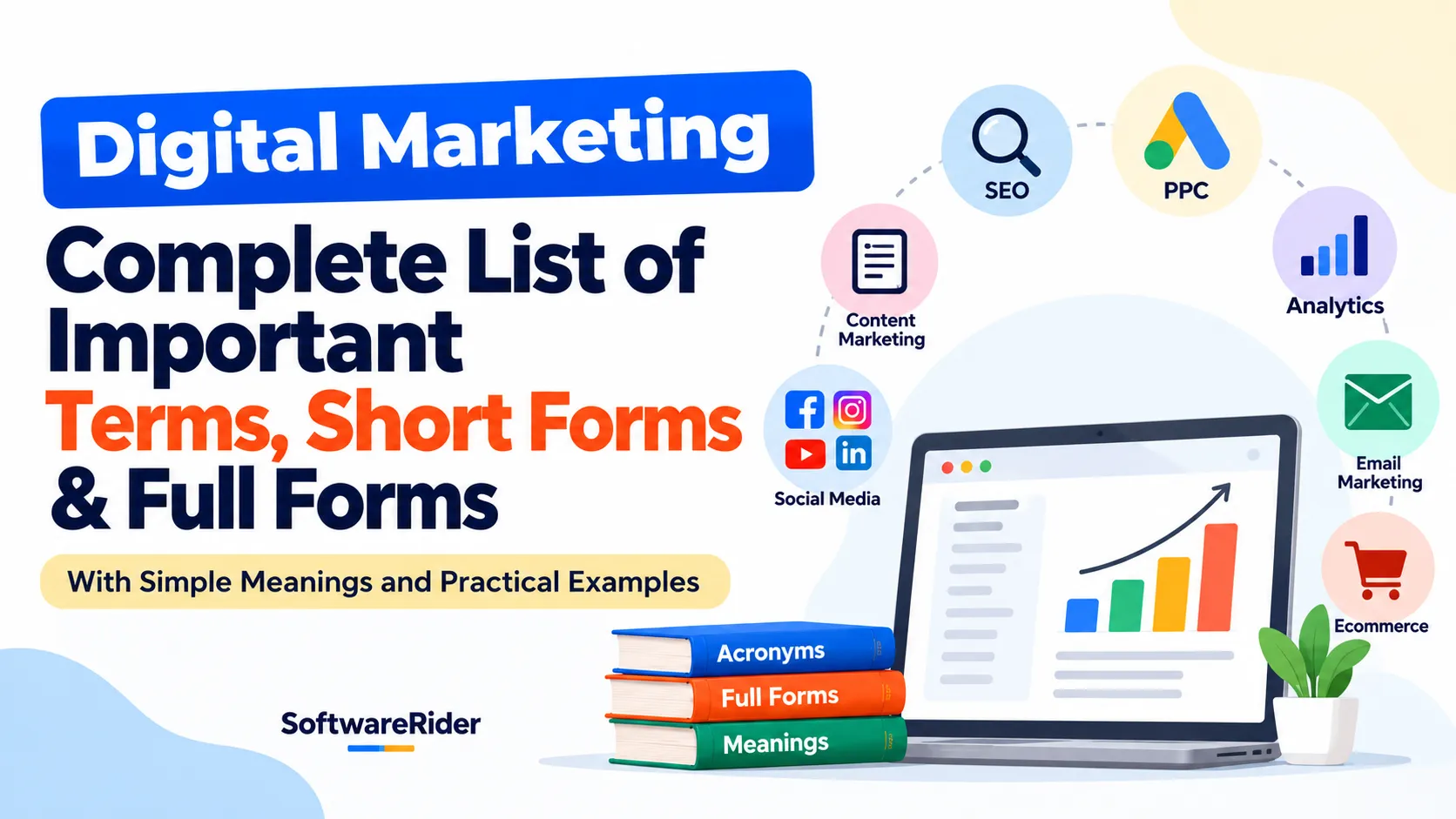
We have organised the terms into practical categories, including SEO, keyword research, paid advertising, Meta Ads, Google Analytics, social media, email marketing and e-commerce. Each term includes its full form and a simple explanation wherever applicable.
What You Will Learn
- Important digital marketing terms and their meanings
- SEO, AEO, keyword research and content marketing terminology
- Google Ads, PPC and Meta Ads abbreviations
- Analytics, tracking and conversion measurement terms
- Social media, email and e-commerce marketing terminology
- Important marketing formulas and performance metrics
- Common acronyms used by digital marketing professionals
Table of Contents
- General Digital Marketing Terms
- SEO – Search Engine Optimization
- Keyword Research and Content Marketing
- Paid Advertising – Google Ads, Meta Ads and PPC
- Meta Ads, Facebook and Instagram Advertising
- Google Analytics, Tracking and Attribution
- Social Media Marketing
- Email Marketing and Marketing Automation
- E-commerce and Marketplace Marketing
- Affiliate Marketing and Influencer Marketing
- Branding, Sales and Customer Behaviour
- Mobile App Marketing
- Web Development and Marketing Technology
- Marketing Strategy, Planning and Reporting
- Video Marketing and Creative Production
- AI, Automation and Emerging Marketing Terms
- Most Important Digital Marketing Formulas
- Digital Marketing Acronyms with Multiple Meanings
- Which Digital Marketing Terms Should You Learn First?
- Frequently Asked Questions
1. General Digital Marketing Terms
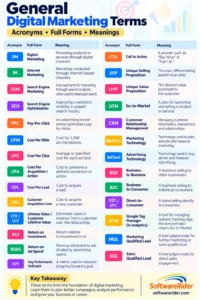
Digital marketing refers to promoting products, services or brands through digital channels such as search engines, websites, social media, email and online advertising.
Before learning specialised marketing techniques, it is useful to understand the basic terminology used across the industry.
| Term / Short Form | Full Form | Meaning |
|---|---|---|
| DM | Digital Marketing | Promoting products or services through digital channels. |
| CTA | Call to Action | A message that encourages users to take an action, such as Buy Now, Sign Up or Learn More. |
| KPI | Key Performance Indicator | A measurable value used to evaluate the success of a campaign or business activity. |
| ROI | Return on Investment | Measures the profit or loss generated compared with the investment made. |
| ROAS | Return on Ad Spend | Measures the revenue generated for every unit of money spent on advertising. |
| USP | Unique Selling Proposition | The special benefit or feature that makes a product or brand different from competitors. |
| UVP | Unique Value Proposition | A clear statement explaining the unique value a business offers to its customers. |
| CRM | Customer Relationship Management | Systems and processes used to manage customer information, interactions and relationships. |
| CX | Customer Experience | The overall experience a customer has with a brand throughout their journey. |
| UX | User Experience | How easy, useful and enjoyable a website, application or product is to use. |
| UI | User Interface | The visual elements of a digital product, such as buttons, menus, forms and layouts. |
| B2B | Business to Business | A business model in which one company sells products or services to another company. |
| B2C | Business to Consumer | A business model in which a company sells directly to individual customers. |
| D2C | Direct to Consumer | A business sells directly to customers without relying on traditional intermediaries. |
| GTM | Go-To-Market | A plan for introducing a product or service to its target market. |
| UGC | User-Generated Content | Content created by customers or users, such as reviews, photos and videos. |
| OM | Online Marketing | Marketing activities carried out through internet-based channels. |
| IM | Internet Marketing | Promoting products and services using the internet. |
Example: How These Terms Work Together
Imagine an online clothing store launching a new collection. The business uses digital marketing to promote its products, a USP to communicate what makes the collection special, a CTA to encourage purchases and KPIs to measure campaign performance.
It can then use CRM software to manage customer relationships and analyse ROI to understand whether the marketing investment is profitable.
2. SEO – Search Engine Optimization
SEO stands for Search Engine Optimization. It is the process of improving a website so that its pages can appear more prominently in unpaid search engine results.
SEO helps websites attract relevant visitors from search engines such as Google and Bing. It includes technical improvements, content optimisation, keyword research and building website authority.
| Term / Short Form | Full Form | Meaning |
|---|---|---|
| SEO | Search Engine Optimization | Improving website visibility in organic search results. |
| SERP | Search Engine Results Page | The page displayed after a user searches for something in a search engine. |
| On-Page SEO | On-Page Search Engine Optimization | Optimising page content, headings, titles, internal links and other page elements. |
| Off-Page SEO | Off-Page Search Engine Optimization | Activities outside a website that help build its authority and reputation. |
| Technical SEO | Technical Search Engine Optimization | Improving technical aspects such as crawling, indexing, site speed and website structure. |
| KW | Keyword | A word or phrase people enter into a search engine. |
| LSI | Latent Semantic Indexing | An older information-retrieval concept often used in SEO discussions. It is not a Google ranking factor or a reliable name for modern keyword research. |
| DA | Domain Authority | A third-party Moz metric that predicts a domain’s ranking potential. It is not a Google ranking factor. |
| PA | Page Authority | A third-party Moz metric that predicts the ranking potential of an individual page. |
| DR | Domain Rating | An Ahrefs metric that estimates the strength of a website’s backlink profile. |
| UR | URL Rating | An Ahrefs metric that estimates the strength of an individual URL’s backlink profile. |
| CTR | Click-Through Rate | The percentage of impressions that result in clicks. |
| GSC | Google Search Console | A free Google tool for monitoring search performance, indexing and website search visibility. |
| XML Sitemap | Extensible Markup Language Sitemap | A file that helps search engines discover important website URLs. |
| Robots.txt | Robots Exclusion Protocol file | A file that gives search engine crawlers instructions about which areas they may access. |
| URL | Uniform Resource Locator | The address of a webpage or other resource on the internet. |
| SSL | Secure Sockets Layer | A legacy name commonly used for the technology behind HTTPS encryption; modern websites use TLS. |
| HTTPS | Hypertext Transfer Protocol Secure | A secure version of HTTP that encrypts data transferred between a browser and a website. |
| ALT | Alternative Text | Text describing an image for accessibility and situations where an image cannot load. |
| NAP | Name, Address and Phone Number | Business contact information used in local SEO and business listings. |
| GBP | Google Business Profile | Google’s business listing platform for managing a business’s presence on Search and Maps. |
| CMS | Content Management System | Software used to create, manage and publish website content. |
| Core Web Vitals | Core Web Vitals | Google’s user-experience metrics covering loading performance, interactivity and visual stability. |
| LCP | Largest Contentful Paint | Measures how quickly the largest visible content element loads. |
| INP | Interaction to Next Paint | Measures responsiveness to user interactions. |
| CLS | Cumulative Layout Shift | Measures unexpected visual movement while a page loads. |
| GEO | Generative Engine Optimization | Practices intended to improve a brand’s visibility in AI-powered search and answer experiences. Usage of this term is still evolving. |
| AEO | Answer Engine Optimization | Structuring useful content so answer engines can understand and surface direct answers. |
Major Types of SEO
- On-page SEO: Improving page titles, headings, content, images and internal links.
- Off-page SEO: Building reputation through relevant backlinks, mentions and other external signals.
- Technical SEO: Improving crawling, indexing, website performance and technical structure.
- Local SEO: Improving visibility for searches connected to a particular location or service area.
Example: SEO in Practice
Suppose you own a website that publishes software tutorials. You write an article targeting the keyword “best free SEO tools”. You create a helpful title, organise the content with headings, add relevant internal links, optimise images and make sure the page can be crawled and indexed.
These activities support SEO. However, rankings are not guaranteed and depend on many factors, including relevance, quality, competition and search engine systems.
3. Keyword Research and Content Marketing
Keyword research helps marketers understand what people are searching for. Content marketing uses useful and relevant content to attract, educate and engage a target audience.
Combining keyword research with a strong content strategy helps businesses create pages that match the needs and questions of their potential customers.
| Term / Short Form | Full Form | Meaning |
|---|---|---|
| KW | Keyword | A search term or phrase used by people to find information, products or services. |
| SV | Search Volume | The estimated number of times a keyword is searched during a given period. |
| KD | Keyword Difficulty | A third-party estimate of how difficult it may be to rank for a keyword. |
| CPC | Cost Per Click | The amount an advertiser pays for a click on an advertisement. |
| Long-Tail Keyword | — | A more specific search phrase, often consisting of several words. |
| Short-Tail Keyword | — | A broad and usually shorter search phrase. |
| LSI | Latent Semantic Indexing | A historical information-retrieval term sometimes used in SEO discussions; it should not be treated as a modern Google keyword category. |
| TF-IDF | Term Frequency–Inverse Document Frequency | A statistical method used in information retrieval to estimate the importance of a term in a document relative to a collection of documents. |
| NLP | Natural Language Processing | A field of AI that helps computers understand and process human language. |
| TOFU | Top of the Funnel | Content designed to attract people who are discovering a topic or problem. |
| MOFU | Middle of the Funnel | Content designed to educate and help people evaluate possible solutions. |
| BOFU | Bottom of the Funnel | Content designed to help people make a purchase or conversion decision. |
| CTA | Call to Action | A prompt that encourages the reader to take the next step. |
| E-E-A-T | Experience, Expertise, Authoritativeness and Trustworthiness | Google’s framework for evaluating aspects of content quality and trust. It is not a single direct ranking factor. |
| UGC | User-Generated Content | Content created by customers or users, such as testimonials, reviews and social posts. |
| CMS | Content Management System | Software used to create, edit and publish digital content. |
| RSS | Really Simple Syndication | A web feed format that allows users or applications to receive updates from websites. |
Types of Keywords
- Informational keywords: Used when people want to learn something. Example: “What is digital marketing?”
- Navigational keywords: Used when people want to find a specific website or brand. Example: “Google Analytics login”.
- Commercial investigation keywords: Used when people compare products or services. Example: “Best email marketing tools”.
- Transactional keywords: Used when people are ready to take action. Example: “Buy hosting plan”.
- Local keywords: Used when people search for services in a particular location. Example: “Digital marketing agency in Patna”.
Example: Keyword Research for a Blog
If you run a technology blog, you might target the main keyword “free AI tools”. Related topics could include free AI writing tools, free AI image generators and free AI tools for students.
These related topics can become separate articles connected through internal links. This creates a useful content structure for readers and helps search engines understand how the pages relate to one another.
4. Paid Advertising – Google Ads, Meta Ads and PPC
Paid advertising allows businesses to promote their products and services by paying for exposure on digital platforms. Common advertising channels include Google Ads, YouTube, Facebook, Instagram and other advertising networks.
Marketers use campaign metrics to measure advertising costs, clicks, conversions and revenue.
| Term / Short Form | Full Form | Meaning |
|---|---|---|
| PPC | Pay Per Click | An advertising model where an advertiser pays when someone clicks an ad. |
| SEM | Search Engine Marketing | Marketing through search engines, commonly used to describe paid search advertising. |
| CPC | Cost Per Click | The cost incurred for each ad click. |
| CPM | Cost Per Mille | The cost for 1,000 ad impressions. “Mille” means one thousand. |
| CPA | Cost Per Acquisition / Action | The average cost of generating a defined acquisition or action. |
| CPL | Cost Per Lead | The average cost of generating one lead. |
| CPI | Cost Per Install | The average cost of generating one app installation. |
| CPV | Cost Per View | A pricing metric used in video advertising, based on qualifying video views. |
| CTR | Click-Through Rate | The percentage of impressions that generate clicks. |
| CVR | Conversion Rate | The percentage of visitors or clicks that complete a desired action, depending on the measurement method. |
| ROAS | Return on Ad Spend | Revenue attributed to advertising divided by advertising cost. |
| ROI | Return on Investment | A measure of the return generated compared with the investment. |
| GDN | Google Display Network | Google’s network of websites, apps and other placements where display ads can appear. |
| RSA | Responsive Search Ad | A Google Ads search ad that combines multiple headlines and descriptions. |
| DSA | Dynamic Search Ads | Search ads that use website content to help generate relevant headlines and landing page destinations. |
| P-MAX | Performance Max | A Google Ads campaign type that uses automation to serve ads across Google’s eligible channels. |
| LP | Landing Page | A webpage designed for a specific campaign, offer or conversion goal. |
| QS | Quality Score | A Google Ads diagnostic rating for keyword-level ad quality, based on expected CTR, ad relevance and landing page experience. |
| Ad Rank | — | A value Google uses to determine ad eligibility and position in an auction. |
| AB Test | A/B Testing | Comparing two versions of an ad, page or other element to understand which performs better. |
| UTM | Urchin Tracking Module | Parameters added to URLs to help identify traffic sources and campaign performance in analytics tools. |
Example: Understanding ROAS
Suppose a business spends ₹10,000 on Google Ads and generates ₹50,000 in attributed revenue.
ROAS = Revenue from Ads ÷ Advertising Cost
ROAS = ₹50,000 ÷ ₹10,000 = 5
This means the campaign generated ₹5 in revenue for every ₹1 spent on advertising. It does not automatically mean the business made ₹4 in profit, because product costs, shipping, taxes and other expenses are not included in this calculation.
5. Meta Ads, Facebook and Instagram Advertising
Meta Ads is the advertising platform used by businesses to run campaigns across Meta’s advertising placements, including Facebook and Instagram. It supports different campaign objectives, audiences, creative formats and optimisation options.
| Term / Short Form | Full Form | Meaning |
|---|---|---|
| Meta Ads | Meta Advertising | Paid advertising across Meta’s eligible platforms and placements. |
| BM | Business Manager | A commonly used name for Meta’s business management environment, now centred around Meta Business Suite and business portfolio tools. |
| ABO | Ad Set Budget Optimization | A commonly used industry term for setting a budget at the ad set level. |
| CBO | Campaign Budget Optimization | An older industry term for campaign-level budget optimisation, now generally referred to as Advantage campaign budget. |
| CTR | Click-Through Rate | The percentage of impressions that generate clicks. |
| CPM | Cost Per Mille | The cost for 1,000 ad impressions. |
| CPC | Cost Per Click | The cost for each ad click. |
| CPA | Cost Per Acquisition / Action | The cost of generating a defined action or acquisition. |
| ROAS | Return on Ad Spend | Revenue attributed to ads divided by ad spend. |
| Pixel | Meta Pixel | A website tracking tool used to measure actions and support advertising measurement and optimisation. |
| CAPI | Conversions API | A system for sending marketing events from a server or other supported source to Meta. |
| Custom Audience | — | An audience created using eligible customer or engagement data. |
| Lookalike Audience | — | An audience designed to find people similar to a selected source audience. |
| Retargeting | — | Advertising to people who previously interacted with a website, app, business or content. |
| Advantage+ | — | Meta’s suite of advertising automation features and campaign solutions. |
| Dynamic Ads | — | Ads that automatically show relevant products or content based on available catalogue and audience signals. |
| AOV | Average Order Value | The average revenue generated per order. |
| Frequency | — | The average number of times each person saw an ad during a selected period. |
| Ad Creative | — | The visual and written elements of an advertisement, such as images, videos, headlines and copy. |
Common Meta Ads Campaign Objectives
- Awareness: Help more people discover or remember a business.
- Traffic: Send people to a website, landing page or other destination.
- Engagement: Encourage interactions such as messages, video views or post engagement.
- Leads: Collect potential customer information or enquiries.
- App promotion: Encourage app installs or other app-related actions.
- Sales: Encourage purchases or other valuable conversion actions.
Example: Meta Ads for an Apparel Brand
An online clothing brand can use a product catalogue to advertise its collection on Facebook and Instagram. It can create different ad creatives, test audiences, track purchases using the Meta Pixel and Conversions API, and compare campaign ROAS.
For a more complete picture, the brand should also review order cancellations, returns, discounts and actual profit—not just the revenue reported by the advertising platform.
6. Google Analytics, Tracking and Attribution
Analytics helps businesses understand how people discover, use and interact with their websites or applications. Tracking tools collect data that can help marketers evaluate traffic sources, user behaviour and conversions.
Google Analytics 4 (GA4) is Google’s event-based analytics platform. It helps businesses measure activity across websites and apps.
| Term / Short Form | Full Form | Meaning |
|---|---|---|
| GA4 | Google Analytics 4 | Google’s event-based analytics platform for websites and apps. |
| UA | Universal Analytics | Google’s previous analytics platform, which has been replaced by GA4 for standard properties. |
| GTM | Google Tag Manager | A tool for managing website and app measurement tags without editing code for every tag change. |
| GSC | Google Search Console | A tool for monitoring website visibility and performance in Google Search. |
| UTM | Urchin Tracking Module | URL parameters used to identify campaign and traffic-source information. |
| CTR | Click-Through Rate | The percentage of impressions that result in clicks. |
| CVR | Conversion Rate | The percentage of users or sessions that complete a defined conversion. |
| CPA | Cost Per Acquisition / Action | The average marketing cost for a defined acquisition or action. |
| ROAS | Return on Ad Spend | Attributed advertising revenue divided by advertising spend. |
| ROI | Return on Investment | A measure of return compared with the investment made. |
| Events | — | Recorded user interactions, such as page views, clicks, downloads or purchases. |
| Key Event | — | An event identified as important to business success in GA4. Previously called a conversion in GA4. |
| Attribution | — | The method used to assign credit for a conversion to marketing touchpoints. |
| UTM Source | — | Identifies where campaign traffic comes from, such as Google, Facebook or a newsletter. |
| UTM Medium | — | Identifies the marketing channel or medium, such as email, CPC or social. |
| UTM Campaign | — | Identifies the specific campaign associated with a link. |
| Engagement Rate | — | In GA4, the percentage of sessions that were engaged sessions. |
| Bounce Rate | — | In GA4, the percentage of sessions that were not engaged sessions. |
| Landing Page | — | The first page a visitor enters during a session, as defined in the relevant reporting context. |
Important UTM Parameters
- utm_source: Identifies the traffic source.
- utm_medium: Identifies the marketing medium.
- utm_campaign: Identifies the campaign name.
- utm_term: Commonly used to identify paid search keywords.
- utm_content: Helps distinguish different links or creatives within a campaign.
Example: Tracking a Social Media Campaign
Suppose you share a blog article on Facebook. You add UTM parameters to the article link so that analytics can identify visits from that campaign.
Example URL:
https://example.com/blog/?utm_source=facebook&utm_medium=social&utm_campaign=seo_guide
This helps you identify Facebook as the source, social as the medium and seo_guide as the campaign name in your analytics reporting.
8. Email Marketing and Marketing Automation
Email marketing is the practice of communicating with customers and subscribers through email. It can be used for newsletters, promotional offers, product updates, educational content and customer retention.
Marketing automation helps businesses send relevant messages based on customer actions, preferences or predefined schedules.
| Term / Short Form | Full Form | Meaning |
|---|---|---|
| EDM | Electronic Direct Mail | A term sometimes used for promotional or marketing email campaigns. |
| ESP | Email Service Provider | A service used to send and manage email campaigns. |
| CTR | Click-Through Rate | The percentage of delivered or measured email messages that generate clicks, depending on the reporting method. |
| CTOR | Click-to-Open Rate | The percentage of unique email openers who clicked a link. |
| OR | Open Rate | The percentage of delivered emails recorded as opened. Privacy features can affect its accuracy. |
| CTOR | Click-to-Open Rate | A metric comparing unique email clicks with unique opens. |
| CTA | Call to Action | A button or link that encourages an email recipient to take action. |
| CRM | Customer Relationship Management | A system for managing customer information and interactions. |
| MA | Marketing Automation | Using software to automate marketing tasks and customer communication. |
| drip Campaign | — | A scheduled series of messages sent over time to a subscriber or customer. |
| Autoresponder | — | An automated email sent after a specific action or trigger. |
| Opt-in | — | A user’s permission to receive marketing communications. |
| Opt-out | — | A user’s choice to stop receiving marketing communications. |
| Unsubscribe Rate | — | The percentage of recipients who opt out of an email list during a campaign. |
| List Segmentation | — | Dividing subscribers into groups based on relevant characteristics or behaviour. |
| Personalization | — | Customising email content based on information about a subscriber or customer. |
| SMTP | Simple Mail Transfer Protocol | A standard protocol used to send email messages. |
| DKIM | DomainKeys Identified Mail | An email authentication method that uses a digital signature to help verify messages. |
| SPF | Sender Policy Framework | An email authentication method that specifies which servers are authorised to send email for a domain. |
| DMARC | Domain-based Message Authentication, Reporting and Conformance | An email authentication policy that builds on SPF and DKIM. |
Common Types of Email Campaigns
- Welcome email: Sent when someone subscribes or creates an account.
- Newsletter: Shares regular updates, useful information and company news.
- Promotional email: Communicates discounts, offers and product promotions.
- Abandoned cart email: Reminds customers about products left in their shopping cart.
- Transactional email: Provides information about orders, payments, account activity or other transactions.
- Re-engagement email: Attempts to reconnect with inactive subscribers or customers.
Example: Automated Welcome Email
When a visitor subscribes to a website newsletter, an automated welcome email can be sent immediately. A few days later, the subscriber may receive a helpful guide or a product recommendation based on their interests.
Businesses should obtain appropriate consent, provide a clear unsubscribe option and follow applicable email and data protection requirements.
9. E-commerce and Marketplace Marketing
E-commerce marketing involves promoting products and services through online stores, shopping websites and digital marketplaces.
Marketplace marketing focuses on improving product visibility and sales on platforms such as Amazon, Flipkart, Myntra and other online marketplaces.
| Term / Short Form | Full Form | Meaning |
|---|---|---|
| ECOM | E-commerce | Buying and selling products or services through electronic networks, especially the internet. |
| D2C | Direct to Consumer | A brand sells directly to customers through its own channels. |
| B2C | Business to Consumer | A company sells products or services to individual customers. |
| B2B | Business to Business | A company sells products or services to another business. |
| AOV | Average Order Value | The average revenue generated per order. |
| GMV | Gross Merchandise Value | The total value of merchandise sold through a marketplace or platform before certain deductions, depending on the platform’s definition. |
| SKU | Stock Keeping Unit | A unique identifier used to track a specific product or variant in inventory. |
| EAN | European Article Number | A product identification barcode standard commonly used in retail. |
| UPC | Universal Product Code | A barcode system used to identify retail products. |
| GTIN | Global Trade Item Number | A globally recognised identifier for trade items. |
| ASIN | Amazon Standard Identification Number | A unique product identification number used within Amazon’s catalogue. |
| COD | Cash on Delivery | A payment method where a customer pays when an order is delivered. |
| RTO | Return to Origin | An order that is returned to the seller or origin, commonly after failed delivery. |
| RTV | Return to Vendor | Goods returned by a retailer or seller to its supplier or vendor. |
| OOS | Out of Stock | A product that is currently unavailable for purchase due to insufficient inventory. |
| PLP | Product Listing Page | A page displaying a collection of products, often with filters and sorting options. |
| PDP | Product Detail Page | A page containing information about an individual product. |
| CR | Conversion Rate | The percentage of visitors or sessions that complete a desired action. |
| MRP | Maximum Retail Price | The maximum retail price printed or declared for a packaged product under applicable rules in India. |
| MOQ | Minimum Order Quantity | The minimum quantity a supplier or seller requires for an order. |
| ASP | Average Selling Price | The average price at which a product is sold during a given period. |
| WMS | Warehouse Management System | Software used to manage warehouse operations and inventory. |
| OMS | Order Management System | Software used to manage orders across sales channels. |
| ERP | Enterprise Resource Planning | Software that helps manage business processes such as finance, inventory and operations. |
| SKU Mapping | — | Matching product identifiers across systems, warehouses or marketplaces. |
| Catalogue | — | A structured collection of product information, images, attributes and variants. |
Important E-commerce Performance Metrics
- Sales: The value of products sold during a selected period.
- Orders: The number of customer orders received.
- AOV: Average revenue per order.
- Conversion Rate: The percentage of visitors or sessions that result in a purchase.
- Return Rate: The percentage of sold items or orders returned, based on the chosen calculation method.
- Cancellation Rate: The percentage of orders cancelled during a selected period.
- RTO Rate: The percentage of shipped orders returned to origin.
- Sell-Through Rate: The proportion of available inventory sold during a given period.
Example: E-commerce Marketing for an Apparel Brand
Imagine an apparel brand selling shirts, trousers and dresses across its own website and multiple marketplaces. Each product has a SKU, size and colour variant. The brand manages product catalogues, inventory, product images, pricing and marketplace advertisements.
To understand performance, the team reviews sales, advertising spend, AOV, conversion rate, cancellations, returns and RTO. Looking at these metrics together gives a more realistic view of business performance than looking at sales alone.
End of Part 1. Continue with Part 2 for Sections 10–19, digital marketing formulas, commonly confused acronyms, learning priorities and frequently asked questions.
10. Affiliate Marketing and Influencer Marketing
Affiliate marketing is a marketing model in which individuals or businesses promote another company’s products or services and earn a commission when qualifying actions take place. Influencer marketing involves collaborating with content creators who have an audience and can help brands build awareness, trust and engagement.
| Term / Short Form | Full Form | Meaning |
|---|---|---|
| AM | Affiliate Marketing | A marketing model where affiliates earn commissions for generating sales, leads or other agreed actions. |
| CPA | Cost Per Acquisition / Action | The cost of generating a defined action or acquisition. |
| CPS | Cost Per Sale | A commission or advertising model in which payment is based on completed sales. |
| CPL | Cost Per Lead | The cost of generating a potential customer or lead. |
| CPC | Cost Per Click | The cost paid for each click in a click-based advertising model. |
| CPM | Cost Per Mille | The cost for 1,000 ad impressions. |
| CTR | Click-Through Rate | The percentage of impressions that generate clicks. |
| ROAS | Return on Ad Spend | Revenue attributed to advertising divided by advertising spend. |
| ROI | Return on Investment | A measure of the return generated compared with the investment. |
| INFL | Influencer | A content creator or public personality who can influence an audience. |
| KOL | Key Opinion Leader | A recognised expert or influential person whose opinions can affect an audience. |
| UGC | User-Generated Content | Content created by customers or users, such as product reviews, photos and videos. |
| Micro-Influencer | — | A creator with a relatively small but often focused audience. |
| Macro-Influencer | — | A creator with a larger audience and broader reach. |
| Affiliate Link | — | A tracked URL used to identify sales or actions generated by an affiliate. |
| Attribution | — | The method used to assign credit for a conversion to marketing touchpoints. |
| Coupon Code | — | A code customers can use to receive a discount or special offer. |
Example: Affiliate Marketing
A technology blogger writes an article reviewing a web hosting service. The blogger includes a tracked affiliate link. If a reader clicks the link and purchases a hosting plan under the programme’s terms, the blogger may earn a commission.
Example: Influencer Marketing
A clothing brand collaborates with a fashion creator to produce a video showing how to style its latest collection. The creator shares the video with their audience, helping the brand reach potential customers.
11. Branding, Sales and Customer Behaviour
Branding helps a business build a recognisable identity and establish a connection with its customers. Sales and customer behaviour analysis help businesses understand how people discover, evaluate and purchase products or services.
| Term / Short Form | Full Form | Meaning |
|---|---|---|
| BR | Brand Recognition | The ability of customers to identify a brand when they see or hear its name or identity. |
| BA | Brand Awareness | The extent to which people know or recognise a brand. |
| BI | Brand Identity | The visual and verbal elements that define how a brand presents itself. |
| BV | Brand Value | The financial or perceived value associated with a brand. |
| USP | Unique Selling Proposition | The distinctive benefit that makes a product or service stand out. |
| UVP | Unique Value Proposition | A statement explaining the unique value a business offers customers. |
| NPS | Net Promoter Score | A metric based on how likely customers are to recommend a business. |
| CLV | Customer Lifetime Value | The estimated value a customer generates over their relationship with a business. |
| LTV | Lifetime Value | Another commonly used name for customer lifetime value. |
| CAC | Customer Acquisition Cost | The average cost of acquiring a new customer. |
| AOV | Average Order Value | The average revenue generated per order. |
| FMCG | Fast-Moving Consumer Goods | Everyday consumer products that sell quickly and are frequently purchased. |
| POS | Point of Sale | The place or system where a customer completes a purchase. |
| CRM | Customer Relationship Management | Tools and processes used to manage customer relationships and interactions. |
| CSAT | Customer Satisfaction Score | A metric used to measure customer satisfaction with a product, service or experience. |
| FOMO | Fear of Missing Out | A psychological feeling that can influence decisions when people believe they may miss an opportunity. |
| CVP | Customer Value Proposition | The value or benefits a product or service promises to deliver to customers. |
| RFM | Recency, Frequency, Monetary | A customer segmentation method based on how recently, how often and how much customers purchase. |
Example: Customer Lifetime Value
Suppose a customer purchases products from an online store several times a year. Instead of evaluating that customer only by their first order, the business estimates the revenue and profit they may generate over the entire relationship.
This helps the business make better decisions about customer retention, loyalty programmes and marketing budgets.
12. Mobile App Marketing
Mobile app marketing focuses on attracting users, encouraging app installations, improving engagement and retaining customers. It includes app store optimisation, paid app campaigns, referral programmes and in-app communication.
| Term / Short Form | Full Form | Meaning |
|---|---|---|
| ASO | App Store Optimization | Improving an app’s visibility and conversion rate in app stores. |
| MAU | Monthly Active Users | The number of unique active users during a month, based on the platform’s definition. |
| DAU | Daily Active Users | The number of unique active users during a day. |
| WAU | Weekly Active Users | The number of unique active users during a week. |
| ARPU | Average Revenue Per User | Average revenue generated per user during a defined period. |
| ARPPU | Average Revenue Per Paying User | Average revenue generated by users who make payments. |
| CPI | Cost Per Install | The average advertising cost for each app installation. |
| CPA | Cost Per Acquisition / Action | The cost of generating a defined user action or acquisition. |
| SDK | Software Development Kit | A collection of tools and resources used to develop software or integrate services. |
| API | Application Programming Interface | A set of rules that allows software applications to communicate. |
| Push Notification | — | A message sent to a device or app user to share updates or encourage engagement. |
| In-App Purchase | — | A purchase made inside a mobile application. |
| Retention Rate | — | The percentage of users who continue using an app after a defined period. |
| Churn Rate | — | The percentage of users or customers who stop using a service during a defined period. |
| Deep Link | — | A link that directs users to a specific location within an app. |
| Install-to-Action Rate | — | The percentage of app installers who complete a selected action. |
Example: Mobile App Marketing
A food delivery business launches a mobile app. It improves the app’s title, screenshots and description in app stores, runs app-install campaigns and sends order updates through push notifications.
The marketing team tracks CPI, daily active users, retention rate and revenue per user to understand how effectively the app attracts and retains customers.
13. Web Development and Marketing Technology
Web development and marketing technology provide the technical foundation for digital marketing. Websites, content management systems, analytics tools, APIs and automation platforms help businesses publish content, collect data and deliver online experiences.
| Term / Short Form | Full Form | Meaning |
|---|---|---|
| HTML | HyperText Markup Language | The standard markup language used to structure webpage content. |
| CSS | Cascading Style Sheets | A language used to style and format webpages. |
| JS | JavaScript | A programming language used to add interactivity and functionality to websites. |
| PHP | PHP: Hypertext Preprocessor | A server-side scripting language widely used in web development. |
| SQL | Structured Query Language | A language used to manage and query relational databases. |
| CMS | Content Management System | Software used to create, manage and publish website content. |
| WP | WordPress | A popular content management system used for websites and blogs. |
| API | Application Programming Interface | A method that allows different software systems to communicate. |
| UI | User Interface | The visual elements through which a user interacts with a digital product. |
| UX | User Experience | The overall experience of using a website, app or product. |
| CDN | Content Delivery Network | A distributed network that delivers website content from servers closer to users. |
| SSL | Secure Sockets Layer | A legacy term associated with encrypted website connections; modern HTTPS uses TLS. |
| TLS | Transport Layer Security | A cryptographic protocol used to secure data communications. |
| DNS | Domain Name System | The system that translates domain names into IP addresses and other DNS records. |
| URL | Uniform Resource Locator | The address of a resource on the internet. |
| HTTP | Hypertext Transfer Protocol | A protocol used to transfer information between web clients and servers. |
| HTTPS | Hypertext Transfer Protocol Secure | The secure version of HTTP using encryption. |
| PHP | PHP: Hypertext Preprocessor | A server-side scripting language commonly used in WordPress development. |
| JSON | JavaScript Object Notation | A lightweight data format commonly used for exchanging information between systems. |
| XML | Extensible Markup Language | A markup language used to structure and store data. |
| SMTP | Simple Mail Transfer Protocol | A protocol used to send email messages. |
| CRM | Customer Relationship Management | Software and processes used to manage customer information and relationships. |
| MarTech | Marketing Technology | Technology and software used to plan, execute and measure marketing activities. |
| CDP | Customer Data Platform | A platform that combines customer data from different sources to create unified customer profiles. |
| SSO | Single Sign-On | An authentication method that allows users to access multiple services with one login. |
Example: Website Technology in Digital Marketing
A business builds its website using WordPress. HTML structures the content, CSS controls the design and JavaScript adds interactive features. A CDN can improve content delivery, while analytics tools measure visitor activity.
Together, these technologies support a website that is easier to manage, measure and improve.
14. Marketing Strategy, Planning and Reporting
Marketing strategy defines how a business will reach its target audience and achieve its objectives. Planning and reporting help teams allocate resources, monitor performance and improve campaigns.
| Term / Short Form | Full Form | Meaning |
|---|---|---|
| STP | Segmentation, Targeting and Positioning | A marketing framework for dividing a market, selecting audiences and positioning a brand. |
| 4Ps | Product, Price, Place and Promotion | The traditional marketing mix framework. |
| 7Ps | Product, Price, Place, Promotion, People, Process and Physical Evidence | An expanded marketing mix commonly used in service marketing. |
| SWOT | Strengths, Weaknesses, Opportunities and Threats | A framework for analysing internal and external business factors. |
| SMART | Specific, Measurable, Achievable, Relevant and Time-Bound | A framework for setting clear and measurable objectives. |
| KPI | Key Performance Indicator | A measurable value used to track progress towards an objective. |
| SOP | Standard Operating Procedure | A documented process for carrying out a task consistently. |
| OKR | Objectives and Key Results | A goal-setting framework that connects objectives with measurable results. |
| MQL | Marketing Qualified Lead | A lead considered more likely to become a customer based on marketing criteria. |
| SQL | Sales Qualified Lead | A lead assessed as ready for direct sales follow-up. |
| GTM | Go-To-Market | A strategy for launching and selling a product or service. |
| ICP | Ideal Customer Profile | A description of the type of customer most suitable for a business. |
| POC | Proof of Concept | A demonstration used to test whether an idea or solution is feasible. |
| QBR | Quarterly Business Review | A review of business performance and priorities, usually conducted every quarter. |
| WBR | Weekly Business Review | A regular review of performance, tasks and business priorities. |
| MOM | Minutes of Meeting | A written record of the discussions, decisions and actions from a meeting. |
| Budget Allocation | — | Dividing available marketing funds across campaigns, channels or activities. |
| Forecasting | — | Estimating future business or marketing performance using available data. |
Example: SMART Marketing Goal
A vague goal might be: “Increase website traffic.”
A SMART goal would be: “Increase organic website sessions by 20% over the next three months by publishing relevant articles and improving existing pages.”
The second goal is clearer because it defines what needs to improve, by how much and within what period.
15. Video Marketing and Creative Production
Video marketing uses video content to educate audiences, demonstrate products, build brand awareness and support sales. Creative production includes the planning, design, editing and delivery of visual and audio assets.
| Term / Short Form | Full Form | Meaning |
|---|---|---|
| VTR | View-Through Rate | A video advertising metric showing the percentage of impressions that resulted in a qualifying view, depending on the platform’s definition. |
| CPV | Cost Per View | The cost associated with a qualifying video view. |
| VSL | Video Sales Letter | A sales message delivered through video. |
| UGC | User-Generated Content | Content created by customers or users. |
| FPS | Frames Per Second | The number of individual frames displayed per second in a video. |
| HD | High Definition | A video resolution category, commonly associated with 720p and 1080p formats. |
| FHD | Full High Definition | A video resolution of 1920 × 1080 pixels. |
| UHD | Ultra High Definition | A high-resolution video category commonly associated with 4K resolution. |
| CTA | Call to Action | A prompt asking viewers to take an action. |
| CTR | Click-Through Rate | The percentage of impressions that generate clicks. |
| VO | Voice Over | Narration recorded separately and added to a video. |
| B-roll | — | Supplementary footage used to support the main video content. |
| Storyboard | — | A visual plan showing the sequence of scenes in a video. |
| Thumbnail | — | A preview image representing a video. |
| Aspect Ratio | — | The proportional relationship between the width and height of an image or video. |
| UGC Ad | User-Generated Content Advertisement | An advertisement designed using customer-style or creator-style content. |
Common Video Formats
- 16:9: Commonly used for YouTube videos and widescreen displays.
- 9:16: Commonly used for vertical short-form videos and Stories.
- 1:1: Square format often used for social media posts.
- 4:5: Portrait format commonly used in social media feeds.
Example: Video Marketing for a Product
An online store can create a short product demonstration video showing the product’s features, benefits and usage. The video can be published on YouTube Shorts, Instagram Reels and other suitable platforms.
The team can then measure views, watch time, engagement and clicks to understand how the video performs.
16. AI, Automation and Emerging Marketing Terms
Artificial intelligence and automation are changing how businesses research, create content, analyse data and communicate with customers. These technologies can help marketing teams work more efficiently, but their output still needs human review.
| Term / Short Form | Full Form | Meaning |
|---|---|---|
| AI | Artificial Intelligence | Technology that enables machines to perform tasks associated with human intelligence. |
| ML | Machine Learning | A branch of AI in which systems learn patterns from data. |
| DL | Deep Learning | A type of machine learning based on multi-layered neural networks. |
| LLM | Large Language Model | An AI model trained on large amounts of text to understand and generate language. |
| GPT | Generative Pre-trained Transformer | A family of AI language models based on the Transformer architecture. |
| NLP | Natural Language Processing | A field of AI focused on enabling computers to process human language. |
| GenAI | Generative Artificial Intelligence | AI that generates content such as text, images, audio, video or code. |
| AEO | Answer Engine Optimization | Optimising content to be understood and surfaced by answer engines. |
| GEO | Generative Engine Optimization | Practices aimed at improving visibility in AI-powered search and answer experiences. |
| AIO | Artificial Intelligence Optimization | An emerging, inconsistently used term for optimising workflows or content using AI. Its meaning depends on context. |
| RAG | Retrieval-Augmented Generation | An AI approach that retrieves relevant information from external sources before generating a response. |
| API | Application Programming Interface | A way for software systems to communicate and exchange data. |
| RPA | Robotic Process Automation | Technology that automates repetitive, rule-based digital tasks. |
| Chatbot | — | Software designed to communicate with users through text or voice. |
| Prompt Engineering | — | Designing instructions and inputs to guide an AI system towards useful outputs. |
| Predictive Analytics | — | Using historical data and statistical or machine-learning methods to estimate future outcomes. |
| Personalization | — | Adapting content, offers or experiences to individual users or audience segments. |
| Automation Workflow | — | A sequence of tasks executed automatically when specified conditions or triggers occur. |
| Computer Vision | — | An AI field that enables computers to interpret images and videos. |
| Multimodal AI | — | AI that can process or generate more than one type of data, such as text, images and audio. |
How AI Helps in Digital Marketing
- Content creation: Helps draft articles, product descriptions, email campaigns and social posts.
- SEO research: Helps organise keyword ideas, analyse content gaps and generate topic suggestions.
- Customer support: Helps answer common customer questions through chatbots.
- Advertising: Helps generate creative variations and analyse campaign data.
- Personalization: Helps tailor recommendations and messages to different audiences.
- Reporting: Helps summarise marketing data and identify patterns.
Example: AI in Content Marketing
A blogger can use an AI tool to brainstorm article topics, prepare an outline and improve a first draft. The writer should then verify facts, add useful experience, edit the content and ensure that the final article genuinely helps readers.
17. Most Important Digital Marketing Formulas
Knowing digital marketing terms is useful, but understanding the formulas behind them is equally important. These calculations help marketers evaluate advertising efficiency, sales performance and customer behaviour.
| Metric | Formula | Example |
|---|---|---|
| CTR | (Clicks ÷ Impressions) × 100 | 100 clicks ÷ 10,000 impressions × 100 = 1% |
| CPC | Advertising Cost ÷ Clicks | ₹1,000 ÷ 200 clicks = ₹5 |
| CPM | (Advertising Cost ÷ Impressions) × 1,000 | ₹2,000 ÷ 50,000 × 1,000 = ₹40 |
| CPA | Advertising Cost ÷ Acquisitions or Actions | ₹5,000 ÷ 50 acquisitions = ₹100 |
| CPL | Advertising Cost ÷ Leads | ₹4,000 ÷ 80 leads = ₹50 |
| CVR | (Conversions ÷ Total Visitors or Clicks) × 100 | 20 purchases ÷ 500 visitors × 100 = 4% |
| ROAS | Attributed Ad Revenue ÷ Ad Spend | ₹50,000 ÷ ₹10,000 = 5x |
| ROI | ((Return − Investment) ÷ Investment) × 100 | (₹15,000 − ₹10,000) ÷ ₹10,000 × 100 = 50% |
| AOV | Total Revenue ÷ Number of Orders | ₹1,00,000 ÷ 200 orders = ₹500 |
| CAC | Total Acquisition Cost ÷ New Customers Acquired | ₹20,000 ÷ 100 customers = ₹200 |
| CLV | Average Purchase Value × Purchase Frequency × Customer Lifespan | ₹500 × 4 purchases × 3 years = ₹6,000 |
| Engagement Rate by Reach | (Total Engagements ÷ Reach) × 100 | 500 engagements ÷ 10,000 reach × 100 = 5% |
| Unsubscribe Rate | (Unsubscribes ÷ Delivered Emails) × 100 | 20 unsubscribes ÷ 2,000 delivered × 100 = 1% |
| Retention Rate | ((Customers at End − New Customers) ÷ Customers at Start) × 100 | (900 − 100) ÷ 1,000 × 100 = 80% |
| Churn Rate | (Customers Lost ÷ Customers at Start) × 100 | 100 lost ÷ 1,000 × 100 = 10% |
| Return Rate | (Returned Units ÷ Units Sold) × 100 | 50 returned ÷ 1,000 sold × 100 = 5% |
Important Notes About These Formulas
- Always define the measurement period before comparing metrics.
- Use consistent definitions for clicks, conversions, customers and revenue.
- ROAS measures advertising revenue relative to ad spend. It is not the same as profit or ROI.
- CAC should include the acquisition costs relevant to the business and measurement period.
- CLV can be calculated in different ways. A revenue-based estimate is not the same as a profit-based customer lifetime value.
- Conversion rate calculations should clearly specify whether the denominator is clicks, users, visitors or sessions.
- Return and cancellation rates should use a consistent order-based or unit-based method.
18. Digital Marketing Acronyms with Multiple Meanings
Some abbreviations have more than one meaning in digital marketing. Their meaning depends on the platform, reporting tool or business context.
| Acronym | Possible Meaning | Context |
|---|---|---|
| CTR | Click-Through Rate | Advertising, SEO and email marketing. |
| CPA | Cost Per Acquisition / Cost Per Action | Paid advertising and campaign measurement. |
| CR | Conversion Rate | Website, e-commerce and advertising reporting. |
| CVR | Conversion Rate | Advertising and website conversion reporting. |
| ROI | Return on Investment | Business, finance and marketing performance. |
| ROAS | Return on Ad Spend | Advertising performance. |
| CRM | Customer Relationship Management | Customer data, sales and marketing. |
| CMS | Content Management System | Website management and publishing. |
| GTM | Google Tag Manager / Go-To-Market | Analytics implementation or business strategy. |
| DM | Direct Message / Digital Marketing | Social media communication or marketing discussions. |
| AI | Artificial Intelligence | Technology, automation and content creation. |
| LSI | Latent Semantic Indexing | Information retrieval and older SEO terminology. |
| CLV / LTV | Customer Lifetime Value / Lifetime Value | Customer value and retention analysis. |
| OR | Open Rate | Email campaign reporting. |
| ER | Engagement Rate | Social media and content performance. |
Tip: Always check the context before interpreting an abbreviation. For example, GTM can mean Google Tag Manager in an analytics discussion or Go-To-Market in a business strategy discussion.
19. Which Digital Marketing Terms Should You Learn First?
You do not need to memorise every digital marketing abbreviation at once. Start with the terms that relate to your role, then gradually learn the terminology used in other areas.
For Digital Marketing Beginners
- Digital Marketing (DM)
- Search Engine Optimization (SEO)
- Social Media Marketing (SMM)
- Call to Action (CTA)
- Key Performance Indicator (KPI)
- Return on Investment (ROI)
- Click-Through Rate (CTR)
- Conversion Rate (CVR)
For SEO Professionals
- SERP – Search Engine Results Page
- GSC – Google Search Console
- CTR – Click-Through Rate
- DA – Domain Authority
- DR – Domain Rating
- NAP – Name, Address and Phone Number
- AEO – Answer Engine Optimization
- GEO – Generative Engine Optimization
- Core Web Vitals – LCP, INP and CLS
For Paid Advertising Professionals
- PPC – Pay Per Click
- CPC – Cost Per Click
- CPM – Cost Per Mille
- CPA – Cost Per Acquisition / Action
- CPL – Cost Per Lead
- CTR – Click-Through Rate
- ROAS – Return on Ad Spend
- CVR – Conversion Rate
For E-commerce Professionals
- SKU – Stock Keeping Unit
- ASIN – Amazon Standard Identification Number
- GMV – Gross Merchandise Value
- AOV – Average Order Value
- COD – Cash on Delivery
- RTO – Return to Origin
- RTV – Return to Vendor
- OOS – Out of Stock
- PDP – Product Detail Page
- PLP – Product Listing Page
For Social Media Professionals
- SMM – Social Media Marketing
- SMO – Social Media Optimization
- UGC – User-Generated Content
- DM – Direct Message
- CTA – Call to Action
- ER – Engagement Rate
- Reach and Impressions
For AI and Content Professionals
- AI – Artificial Intelligence
- ML – Machine Learning
- LLM – Large Language Model
- GPT – Generative Pre-trained Transformer
- NLP – Natural Language Processing
- GenAI – Generative Artificial Intelligence
- RAG – Retrieval-Augmented Generation
- AEO – Answer Engine Optimization
20. Frequently Asked Questions About Digital Marketing Terms
1. What are digital marketing terms?
Digital marketing terms are words, abbreviations and technical expressions used to describe online marketing activities, tools, strategies and performance metrics. Examples include SEO, PPC, CTR, CPC, ROAS and CRM.
2. What is the full form of SEO?
SEO stands for Search Engine Optimization. It is the process of improving a website’s visibility in organic search engine results.
3. What is the full form of SEM?
SEM stands for Search Engine Marketing. It is commonly used to describe paid search advertising, although the term can also be used more broadly for marketing through search engines.
4. What is the difference between SEO and SEM?
SEO focuses on improving organic visibility in search results. SEM is often used to describe paid search campaigns. In broader usage, SEM can include both paid and organic search marketing.
5. What is the full form of PPC?
PPC stands for Pay Per Click. It is an advertising model in which advertisers pay when someone clicks their advertisement.
6. What is the full form of CPC?
CPC stands for Cost Per Click. It measures the amount paid for each ad click.
7. What is the full form of CPM?
CPM stands for Cost Per Mille. It measures the cost of 1,000 advertising impressions.
8. What is the full form of CTR?
CTR stands for Click-Through Rate. It measures the percentage of impressions that result in clicks.
9. What is the full form of CPA?
CPA commonly stands for Cost Per Acquisition or Cost Per Action. It measures the cost of generating a defined acquisition or action.
10. What is the full form of ROAS?
ROAS stands for Return on Ad Spend. It measures attributed advertising revenue relative to advertising cost.
11. What is the difference between ROI and ROAS?
ROAS compares revenue attributed to advertising with advertising spend. ROI measures the return relative to the overall investment and can account for costs beyond advertising spend. They are not interchangeable.
12. What is the full form of CRM?
CRM stands for Customer Relationship Management. It refers to the systems and processes businesses use to manage customer information and interactions.
13. What is the full form of CTA?
CTA stands for Call to Action. Examples include Buy Now, Sign Up, Download, Contact Us and Learn More.
14. What is the full form of KPI?
KPI stands for Key Performance Indicator. It is a measurable value used to track progress towards a business or marketing objective.
15. What is the full form of AOV?
AOV stands for Average Order Value. It is calculated by dividing total revenue by the number of orders during a selected period.
16. What is the full form of SKU?
SKU stands for Stock Keeping Unit. It is a unique identifier used to manage individual products or product variants in inventory.
17. What is the full form of RTO in e-commerce?
RTO stands for Return to Origin. It refers to a shipment that returns to the seller or origin, commonly after a delivery attempt fails.
18. What is AEO in digital marketing?
AEO stands for Answer Engine Optimization. It refers to structuring useful content so answer engines can understand and surface direct answers to users’ questions.
19. What is GEO in digital marketing?
GEO stands for Generative Engine Optimization. It describes practices intended to improve a brand’s visibility in AI-powered search and answer experiences.
20. How can I learn digital marketing terminology?
Start by learning the basic terms used in SEO, social media, paid advertising and analytics. Practise with real campaigns and tools such as Google Analytics, Google Search Console and advertising platforms. Understanding how metrics are calculated is more useful than simply memorising their full forms.
Final Thoughts
Digital marketing includes many terms, abbreviations and performance metrics. Understanding them makes it easier to plan campaigns, analyse results, communicate with clients and make better business decisions.
You do not need to learn everything in one day. Start with the fundamentals, understand the metrics related to your work and gradually explore advanced topics such as technical SEO, attribution, marketing automation, AI and e-commerce analytics.
Keep this guide bookmarked and return to it whenever you come across an unfamiliar digital marketing term.
About SoftwareRider
SoftwareRider shares practical information about software, AI tools, digital marketing, SEO, website development and online business. Our goal is to make technology easier to understand through simple explanations, useful tutorials and practical guides.
Explore more guides and tutorials at SoftwareRider.com.

7. Social Media Marketing
Social media marketing involves using social platforms to build brand awareness, connect with audiences, publish content, generate leads and support sales.
Businesses use both organic content and paid advertising to reach their target audience.
Popular Social Media Platforms
Example: Social Media Marketing for a Small Business
A local clothing store can publish product photos, short styling videos, customer reviews and festival offers. It can respond to customer questions through direct messages and use engagement and reach data to understand which content attracts attention.